
Sin of Angels: The Outlaw Motorcycle Club Strategy Board Game

Sin of Angels is an outlaw motorcycle club strategy game built to run right in your browser, no install required. You step in as club president, build a crew, claim territory across six rounds, and settle disputes with rival clubs in a cinematic 3D Brawl. The game is in closed beta now, so the fastest way in is the beta list.
Your role: club president. You step into the boots of a club president. You build your crew, muscle rival factions off the streets, and control The Silk Road.
Three ways to play. We built this game to fit how your crew actually plays. You can run it solo against a smart AI opponent. You can fire it up online with friends across different devices. Or you can throw the 3D board up on a TV for party mode, where everyone in the room plays from their own phone.
There are no downloads and no installs. Once the beta opens your seat, you drop in, claim your turf, and ride.
Key Takeaways
- You play as a club president, bringing in Members and Recruits to claim territory.
- Sites generate Cash, Guns, and Narcotics, the three resources you spend as Orders.
- Rival clubs clash in a cinematic 3D Brawl, not a dice roll, when they contest a site.
- The club holding the most Cash when Round 6 ends wins.
- Play solo against a smart AI, online multiplayer, local pass-and-play, or TV party mode.
The Digital Board Game Experience
Argues the game isn't the 'mobile idle-management sim' or 'arcade racer' dead ends, and explains phone-hidden cards replace fumbling secret hands at a table.
Players looking for a real biker gang game usually run into the same two dead ends. One is a mobile idle-management sim that practically plays itself. The other is an arcade racer where you swing a chain at passing traffic.
Sin of Angels is neither of those things.
A Real Board Game, Digitized
This is a heavy, turn-based digital board game. It takes the deep, ruthless mechanics of the best area control board games and strips away the cardboard.
You do not tap a screen to wait for a timer to count down. You make hard choices, position your riders, cut deals, and break them.
Territory Is the Whole Game
This is a territory control game at its core. You are fighting over a finite map, and every inch of turf matters. If you want the docks to run narcotics, you have to take them from someone else.
It brings the tension of strategy board games for adults into a gritty, modern crime setting. You manage resources, deploy your patched members, and outsmart the opposition.
Your Secrets Stay Secret
The digital format handles the math, the setup, and the teardown, so you just focus on the strategy. In a physical board game, keeping your cards secret while negotiating across a table can be clumsy.
In Sin of Angels, your phone holds your hand of cards, so your secrets stay in your palm. You can plot a massive betrayal without giving away a single tell. You look at the board, find the weak point in your rival's defense, and you strike.
The Core Loop of the Club

The core loop of this motorcycle club game runs on six rounds of escalating violence and broken alliances. You start small, building your crew by bringing in patched Members and hungry Recruits. Every rider is a piece on the board, and you need them to project power.

- Recruits are cheap and expendable. You send them to do the dirty work.
- Members are your patched brothers. They hit harder in a fight, but losing one hurts the club's standing.
Managing who you send to a site is a critical tactical decision. A club with no muscle is a club that gets bled dry by the end of the first round.
Once your crew is ready, you take territory. You move your riders onto the town's key sites, and every location is a front you use. These sites generate Cash, Guns, and Narcotics, the lifeblood of your operation:
- You need Cash to pay your crew and keep them loyal.
- You need Guns to hold your turf when the talking stops.
- You need Narcotics to trade on The Silk Road for massive payouts.
Running the economy takes focus. You spend your Orders each turn to maneuver your crew and execute your plans. You trade your illicit goods to build a war chest.

The Economy: Silk Road and Felonies
Timing the market matters. The Silk Road is not just a store. It is a fluctuating economy, so you have to time your trades. Selling Narcotics when the market is flooded gets you nothing. Holding onto it makes you a target for rival clubs looking to steal your stash.

Managing Felonies is its own game. Push too hard, and the law comes down on your club. Keep your Felonies low. Otherwise you pay the price when the sirens sound and the cops lock down your most profitable sites.
Diplomacy and Betrayal
Alliances hold the peace, barely. This is a gang war board game, and you cannot win without getting your hands dirty. You will need to cut ceasefires and alliances with rival clubs. You negotiate borders and agree to split the profits of a lucrative site to keep the peace.
Betrayal is the payoff. Then, when the time is right, you break those deals. You look another player in the eye, promise them safe passage, and then torch their operation.
The Brawl and the Win Condition
The Brawl settles it. When clubs clash on the same site, it sparks a Brawl. This is not just a dice roll on a table. Brawls are settled as cinematic 3D battles, where you commit your guns, call in backup, and watch your crew fight it out in the dirt.
Winning means the most cash. The club holding the most Cash when Round 6 ends wins the game. Territory is how you earn that cash, and the Envelope marks turn order and breaks ties. You bleed the town dry, and you leave the rest in the dust.
You just read the entire core loop. Sin of Angels is in closed beta, and the list is open now. Join the Beta
Three Ways to Play
Sin of Angels works natively on desktop, tablet, and phone, right in your browser, with no downloads. Even iPhone users play right in the browser.
A native Android app and a PC release via Steam are planned for the future. The browser build is the core experience, designed around three distinct ways to play.
First: Solo
We built a smart AI opponent that understands territory control. It does not just make random moves. It will exploit your weak flanks, and it will break ceasefires when it serves its interests.
It is a perfect way to test your strategies before you face real people. Sometimes you just want to test a new opening strategy, or see if rushing The Iron Works early pays off. The solo vs AI mode lets you run those simulations.
The AI does not cheat. It uses the same rules and resources you do. It just plays smart.
Second: Online Multiplayer
Connect with friends across different devices. It does not matter if one person is on a laptop and another is on a phone. The browser handles all of it.
You can run a full game night with remote players. Scheme in private chats, form alliances, and backstab your friends from across the country.
Third: Party Mode
This is a board game you play on the TV. You cast the 3D board to your big screen, and everyone in the room connects using their own phone as a private controller.
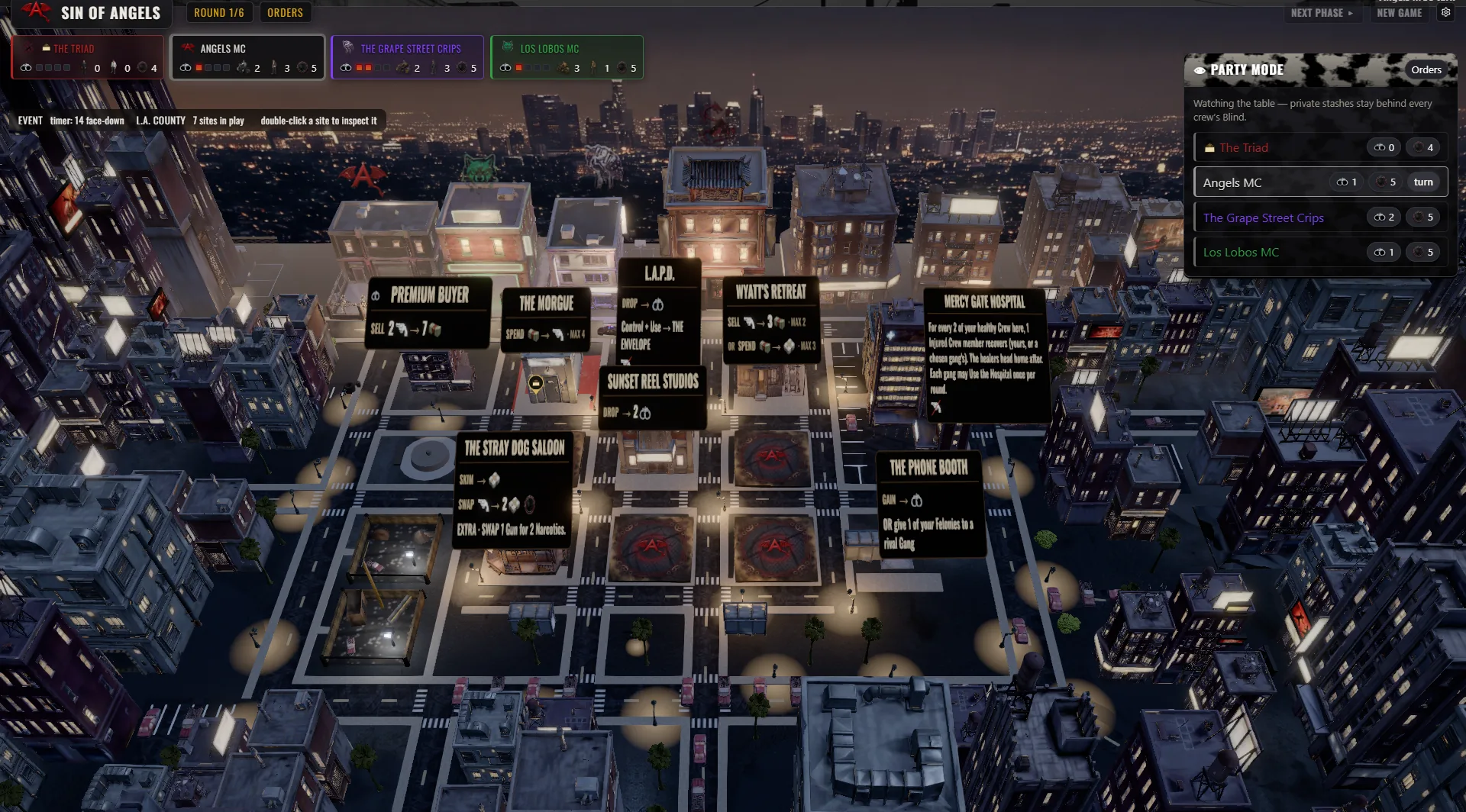
You look at your hand of cards in secret and plot your moves. Then you look up at the TV to watch the chaos unfold. It is the perfect setup for a local game night.
If you are hanging out at a bar or sitting around a coffee table, you can also run a local pass-and-play match on a single tablet. You take your turn, make your moves, and slide the screen to the next president.
The World and the Vibe
Covers the L.A. underbelly setting's front locations, the outlaw-country/dark-Americana soundtrack, and the memento-mori death vignettes.
The setting of Sin of Angels is the underbelly of L.A. County, a place built on bad decisions and dirty money. Every location is a front to use, including:
- Dive bars
- A gun shop
- A morgue
- A drug lab
- The strip joint
- High Desert Trading Post
- The highway out of town
A tight, hostile map. The town is a character itself. The map is tight, forcing clubs to bump shoulders early. You cannot sit in a corner and build an engine in peace, because the geography demands conflict.
If you control the highway out of town, you control the flow of goods. But holding the highway also means you are surrounded by enemies.
Leather, chrome, and outlaw-country. We wanted this to feel authentic to the best crime dramas. The world is leather, chrome, and exhaust fumes. Every location has its own ambient soundscape. The game features a full original soundtrack of outlaw-country and dark-Americana music.
The sound effects are punchy and brutal. When a gun goes off, you feel it.
Death has weight. When a rider goes down in a Brawl, they do not just vanish from the board. The game plays atmospheric memento-mori death vignettes. These cutscenes remind you that every choice has a body count. You can even browse the cards, cinematics, and music from an in-game library.
Who It Is For
Matches the game to five player types: tabletop area-control fans, TV game-night hosts, remote friend groups, solo players, and MC-drama fans.
This game is built for a specific kind of player.
- Board-game and tabletop-strategy fans who love area control mechanics. If you like negotiation, alliances, and moving pieces on a map, this is your turf. The digital format handles the bookkeeping, letting you focus entirely on outsmarting your opponents.
- Game-night hosts. If you want something fresh to throw on the TV while everyone drinks and plays from their phones, this fits the bill perfectly. It is easy to drop into, but deep enough to keep people arguing over turf for hours.
- Online friend groups. If your crew is scattered across the country, you can jump into a browser and run a ruthless gang war without needing to coordinate downloads or buy expensive hardware.
- Solo strategy players. The AI provides a real challenge. You can sit down for a quick match against a machine that plays like a veteran shot caller.
- Fans of outlaw-biker crime dramas. If you love the gritty Americana of MC culture, this game lets you live it. You run the club, you make the calls, and you deal with the fallout.

Why an Area-Control Board Game is What Players Want
Gives a 3-question test for spotting a genuine biker strategy game, then links to related guides and the beta signup.
Players have asked for a real biker strategy game for years, and the market answered with shallow mobile apps. They gave you timers to click and microtransactions to buy. They missed the point of what makes an outlaw motorcycle club compelling: brotherhood, territory, and betrayal.

That is why an area-control board game is the right format. You need a map to fight over. You need finite resources to force conflict. You need the ability to look another player in the eye, promise them safe passage, and then torch their operation.
How to spot a real biker strategy game. Most "outlaw MC" games fall into one of the two dead ends already covered above: a mobile idle sim, or an arcade racer. Run any game you are considering through three questions instead of taking the marketing at its word:
- Does a match force real, permanent choices, instead of idle timers ticking down?
- Can you form an alliance with another player, and actually break it later?
- Does it scale from a quick solo run to a full table, without new hardware or downloads?
Sin of Angels is built to answer yes to all three. It takes the mechanics of heavy strategy board games and wraps them in a digital package accessible to anyone with a phone.
Learn the mechanics. If you want more on the engine driving the game, check out our guide on how worker placement and area control mechanics work. If your group loves the big-screen format, explore other party games you play on the TV with your phone.
Understand the culture. Tabletop purists can read the outlaw-MC board game comparison for fans of the genre to see how digital adapts the cardboard experience. We also explore the history behind the lifestyle, explaining what the 1% patch and outlaw-MC culture actually mean.
And if you just want to conquer a map with your friends right now, check out our roundup of online area-control games like Risk.
Get In Early
Sin of Angels is in closed beta at soa-game.com. Get on the list and you play early, and the bugs you report help shape what ships.
Related Guides
- Games Like Risk You Can Actually Play Online (Free)
- The Outlaw-MC Board Game for Fans of the Genre
- What Does 1% Mean for Bikers? Outlaw MC Culture Explained
- Games Like Jackbox That Use Your Phone
- Worker Placement Board Games: How the Mechanic Works
Frequently Asked Questions
What is Sin of Angels?
Sin of Angels is a turn-based strategy and area-control digital board game about running an outlaw motorcycle club. You build a crew, fight rival gangs for territory, and work The Silk Road in L.A. County. It is played entirely in your browser with no installation required.
How do you play Sin of Angels?
You bring in patched Members and Recruits, then move them onto the town's sites to generate Cash, Guns, and Narcotics. You use these resources to trade on The Silk Road and manage your Felonies with the law. Players cut alliances, break deals, and resolve turf wars through cinematic 3D Brawls. The gang holding the most Cash when Round 6 ends wins.
Can you play Sin of Angels solo against the AI?
Yes, the game features a smart AI opponent designed for solo strategy players. The AI understands territory control, will exploit your weak flanks, and knows exactly when to break a ceasefire. It provides a full, challenging game experience even when your friends are offline.
What platforms can you play Sin of Angels on?
The game is completely browser-based, meaning you can play it on desktop, tablet, and phone across all operating systems, including iPhone. A native Android app and a PC release via Steam are also planned for the future.
How many players can play Sin of Angels?
A single match supports around two to six gangs fighting for control of the town. You can fill these slots with any combination of human players and AI opponents. This makes it easy to scale the game for a massive group or an intimate head-to-head match.
How long does a game of Sin of Angels take?
A standard game lasts for about six rounds of escalating conflict. Depending on the player count and the amount of negotiation happening at the table, it can fill a full game night or serve as a quick, brutal match. The digital format handles all the math, keeping the pace fast.
What is party mode in Sin of Angels?
Party mode lets you cast the 3D game board to a TV while everyone in the room uses their own phone as a private controller. You manage your cards and secret plans on your screen, then look up at the TV to watch the gang fights and map changes unfold together.
Claim Your Turf
Sin of Angels gives you the keys to the club, letting you run your crew online, solo, or on the big screen with your friends. The streets are waiting for a new shot caller, and the beta list is how you get there first. Claim Your Spot in the Beta