
The Best 2-Player Games for Couples

The best 2 player games for couples hit the table fast, keep both of you engaged, and scale to exactly two people, think 7 Wonders Duel, Patchwork, or a fast browser pick like Sin of Angels. Most group games fall apart when you strip the player count down to two: the map feels empty and the mechanics get loose.
Whether you share a couch or play long-distance across time zones, the rules change when it is just the two of you. You want high stakes, tight mechanics, and zero dead time. We are breaking down what makes a game actually work for two adults, from tabletop strategy to digital co-op.
Key Takeaways
- Tight two-player picks: 7 Wonders Duel, Targi, and Patchwork test you head-to-head with zero dead air.
- It Takes Two leads cooperative digital play when you want to team up instead of fight.
- Setup friction kills game nights fast, so card games and browser strategy beat sprawling boards.
- Sin of Angels is in closed beta: free in-browser, no install, solo, local, online, or TV party mode once you are in.
- Pick competitive for a head-to-head fight or cooperative when you would rather team up.
The Top Picks for Two Players
The best picks strip away the fat and focus entirely on the head-to-head dynamic.

- 7 Wonders Duel forces you into a tight economic race where every card you draft directly hurts your opponent.
- Targi turns worker placement into a ruthless desert grid where you block each other at every turn.
- Patchwork has you fighting over scraps of fabric and buttons in a surprisingly aggressive economy.
- Sin of Angels puts you and your partner in charge of rival motorcycle clubs clawing over the same turf, free in the browser with no install. It is in closed beta right now, so you join the list and get in as spots open up.
- It Takes Two forces you to work together through a massive puzzle-platformer where communication is your only survival tool. It dominates the market for 2 player video games for couples because it physically cannot be played alone.
| Game | Format | Dynamic | Best For |
|---|---|---|---|
| 7 Wonders Duel | Tabletop card game | Competitive | A tight, fast economic race (2 players, 30 min, complexity 2.23/5) |
| Targi | Tabletop board game | Competitive | Ruthless worker-placement blocking (2 players, 60 min, complexity 2.34/5) |
| Patchwork | Tabletop board game | Competitive | A quiet, aggressive resource puzzle (2 players, 15-30 min, complexity 1.60/5) |
| Sin of Angels | Digital browser board game | Competitive | A fast, free turf war on your phones once the beta opens, no box or setup (2-6 players, about six rounds, not BGG-rated) |
| It Takes Two | Digital puzzle-platformer | Cooperative | Couples who want to work together, not against each other |
The Anatomy of a Perfect Two-Player Game
Walks through picking criteria: setup speed, format, console co-op, length, and theme.
A game earns a spot on your table by respecting your time, forcing real interaction, and refusing to lean on a crowd to create tension. Not every box on the shelf clears that bar.

When you sit down after a long day, you do not want to wrestle with a massive rulebook. You do not want to set up a sprawling board just to play a ghost version of a four-player game. Three things decide whether a game survives that test:
- Setup friction. How long from opening the box to your first move?
- Group size scaling. Does the game still work when you cut it down to two, or does it just feel emptier?
- Remote accessibility. Can you still play it if you are not in the same room?
Call it the Three-Question Turf Test. Ask it before you buy anything on this list, digital or physical. If a game fails two of the three, it stays in the box.
The Player Count Problem
A box that says it plays one to five people usually plays best at four. Drop that down to two and the cracks show fast. The board is too big, so you end up building your own engines in opposite corners without ever crossing paths. That is not a game. That is solitaire in the same room.
The best 2 player board games for couples tighten the screws instead. They shrink the map and force you to fight over the same limited resources. If you want a piece of turf, you take it from the person across from you. There is no hiding in the corner, and no third player around to balance the scales.
Cut that dead weight. Some games try to patch the two-player problem with a dummy player, an artificial third faction you have to manage just to make the rules work. Cut that dead weight. A true two-player game stands on its own. The mechanics sing head-to-head. Every move matters. Every mistake gets punished.
Setup Friction and the Mental Toll
Setup friction kills more game nights than bad rules do. When the workday ends, your patience for a complicated setup drops to zero. If it takes thirty minutes to punch out tokens, shuffle five decks, and arrange a massive board, you will choose the television instead.
This is where 2 player card games for couples win. You open the box, deal the cards, and play. The barrier to entry is nonexistent.
- Card games distill complex strategy into a fast format.
- You can run three or four matches in the time it takes to set up one heavy strategy board game.
- The best 2 player board games for adults balance depth with a clean setup, organized components, and action by turn one.
But sometimes you want the heavy strategy anyway. You want the tactile pull of moving pieces and claiming territory. That is fine, as long as the payoff matches the work. If a game needs a spreadsheet to track your economy, it better deliver something massive in return. Otherwise it is just work.
Tabletop vs Digital: Choosing Your Turf
Cardboard and screens each solve a different problem, so the right pick depends on what you need that night. Tabletop games pull you away from digital noise. You handle physical pieces and read your opponent across the table. It is a grounded experience.
Digital games solve for speed. They track the score, enforce the rules, and set up instantly, which is why the market for 2 player video games for couples is so large. You press a button and you are in.
- No shuffling, no math. The engine calculates combat modifiers instantly, so momentum stays high. A digital strategy game that resolves in forty-five minutes might take a physical board two hours to work through the same combat phases.
- State stays saved. If the dog barks or the phone rings, you close the laptop and the game waits. A physical board left out for three days gets pieces bumped or lost. Digital respects your space.
Cardboard still has an edge screens cannot replicate. You spend all day staring at monitors already, so a physical board game demanding your presence is a feature, not a bug. You hear the dice hit the table. You hold the cards in your hand. You watch your partner react in real time.
Sliding a plastic miniature onto your opponent's territory and declaring an attack carries a weight that clicking a mouse does not. The best collections keep both formats around: heavy cardboard for the weekends, digital for quick weeknight skirmishes.
Sin of Angels splits the difference: a real strategy board on your screen, no shuffling, no setup, just a beta invite away for you and your partner. Join the Beta
Consoles and Local Co-op
Finding a game two people can play on one television now takes actual research, because most developers assume everyone buys their own copy and plays on their own screen. Split-screen used to be the standard. It is not anymore.
- PS5: Finding 2 player ps5 games for couples means digging through digital storefronts for indie titles that still support local co-op, since big blockbusters rarely bother with split-screen anymore.
- Xbox: Browsing for 2 player xbox games for couples usually points you toward the Game Pass library, where subscription access lets you test a co-op game for twenty minutes and delete it if it does not hook you.
- Switch: The market for 2 player switch games for couples stays strong because the hardware is built for it. Detach the controllers and start a match anywhere.
Long-Distance and Remote Play
Not every couple shares a zip code, and you cannot slide a deck of cards across a video call. Travel, work, and long-distance relationships need a different kind of game, one built on digital infrastructure from the start.
Run smoothly online. The demand for 2-player games for couples online has pushed the industry to adapt. You need games that run smoothly over a network connection, with voice chat as a given so you can hear the reaction when you steal their territory.
Load and play. Browser-based games offer the lowest barrier to entry. No matching consoles, no expensive gaming PCs required. If you both have a laptop and an internet connection, you share a link, load the page, and start making moves.
Remote play together. Steam remains the heavyweight for PC gaming, with thousands of remote-play options. Some titles even support remote play together, where one person owns the game and the other streams it for free, cutting the cost of long-distance gaming in half.
That "share a link, load the page" itch is exactly what Sin of Angels was built to scratch, no console to match and no download to wait on.
Competitive vs Cooperative Dynamics

The first decision is simple: do you want to crush your partner, or team up against the game?
Competitive games test the relationship directly. You fight for the same resources, block their moves, and bleed their economy dry. A good competitive game leaves no room for mercy. Pull your punches and the mechanics break. The best titles give you real tools to outsmart your opponent instead of leaning on luck, so a win actually feels earned.
Cooperative games flip the script. It is both of you against the board, sharing resources and planning turns together. If one of you fails, both of you lose. Co-op games demand constant communication. You cannot run off and do your own thing; you operate as a single unit while the game escalates the pressure and forces you to adapt.
Game Length and Session Commitment

The right game length depends on the night, not the box. A Tuesday needs something different than a lazy Sunday.
- Short games act as filler, fifteen to thirty minutes. You can play a best-of-three while dinner is in the oven. Tight, repetitive loops teach the mechanics fast, and depth comes from reading your opponent.
- Medium games demand an hour or two, the sweet spot for a dedicated game night. There is time to build an engine, execute a long-term strategy, and watch it unfold. These require focus, not a phone in your other hand.
- Campaign games ask for a real commitment, played over weeks or months with decisions carrying forward between sessions. You level up characters, alter the board, and unlock new rules. Leave the board set up on a dedicated table, or you will never finish.
The Importance of Replayability
A game earns replay value when it changes shape every time you open the box. If a game plays the exact same way twice, it collects dust after three sessions.
Replayability comes from variable setup: the board shifts, available resources shift, and no single path to victory can be memorized. Asymmetric games do this especially well.
Each player follows different rules, so you might control a massive, slow-moving army while your partner runs a small, fast-moving strike team. Different win conditions mean playing from the other side feels like a new game, which doubles the lifespan of the box.
Information and Bluffing

Whether a game rewards pure calculation or reading your partner's face comes down to how much information it hides. Perfect information games lay everything on the table. Chess is the classic example: you see every piece, know every possible move, and the better player wins on skill alone.
Hide your hand. Hidden information games introduce chaos instead. You hold cards in your hand or hide resources behind a screen, so you never know exactly what your opponent is planning. That opens the door to bluffing: baiting a bad move, or pretending to be weak while holding a massive combo.
Bluffing games work especially well for couples, because you already know how to read each other. You know their tells. You know when they are lying. Using that against them is half the fun.
Theme and Atmosphere
Mechanics get you through the rules, but theme is what pulls you in. A dry game about trading cubes in the Mediterranean can have perfect math and still lack teeth. You want a world you can sink into.
Claim territory. When you fight over a gritty California town, running narcotics and muscling rival gangs off their turf, every decision carries more weight. You are not just moving wooden pieces; you are claiming territory, cutting deals, and breaking them. A strong theme makes the mechanics hit harder, giving context to the violence on the board.
Couples often gravitate toward themes that contrast with their daily lives. You deal with spreadsheets and emails all day. When you sit down to play, you want to run a cartel, command a starship, or survive a zombie apocalypse. The best games commit fully to the setting, artwork and rules included.
The Role of AI in Two-Player Games
An AI opponent lets both of you compete without pointing the competition at each other. Sometimes you want the mechanics of a strategy game without the domestic friction, and that is where a bot fits in.
- A smart AI runs its own economy, takes territory, and forces both of you to react.
- You can call a temporary ceasefire with your partner to deal with the AI threat, then turn on each other when it benefits you.
- Digital board games handle this without any manual flowcharting: the computer runs the bot, you focus on strategy.
A ruthless AI opponent can turn a standard two-player match into a three-way fight for survival.
But sometimes you do not want to cooperate. Sometimes you want to run an empire, claim territory, and bleed your opponent dry. You want a game with teeth.
How Sin of Angels Fits the Bill
Goes deep on Sin of Angels' crew, turf-war mechanics, platforms, and the beta signup link.
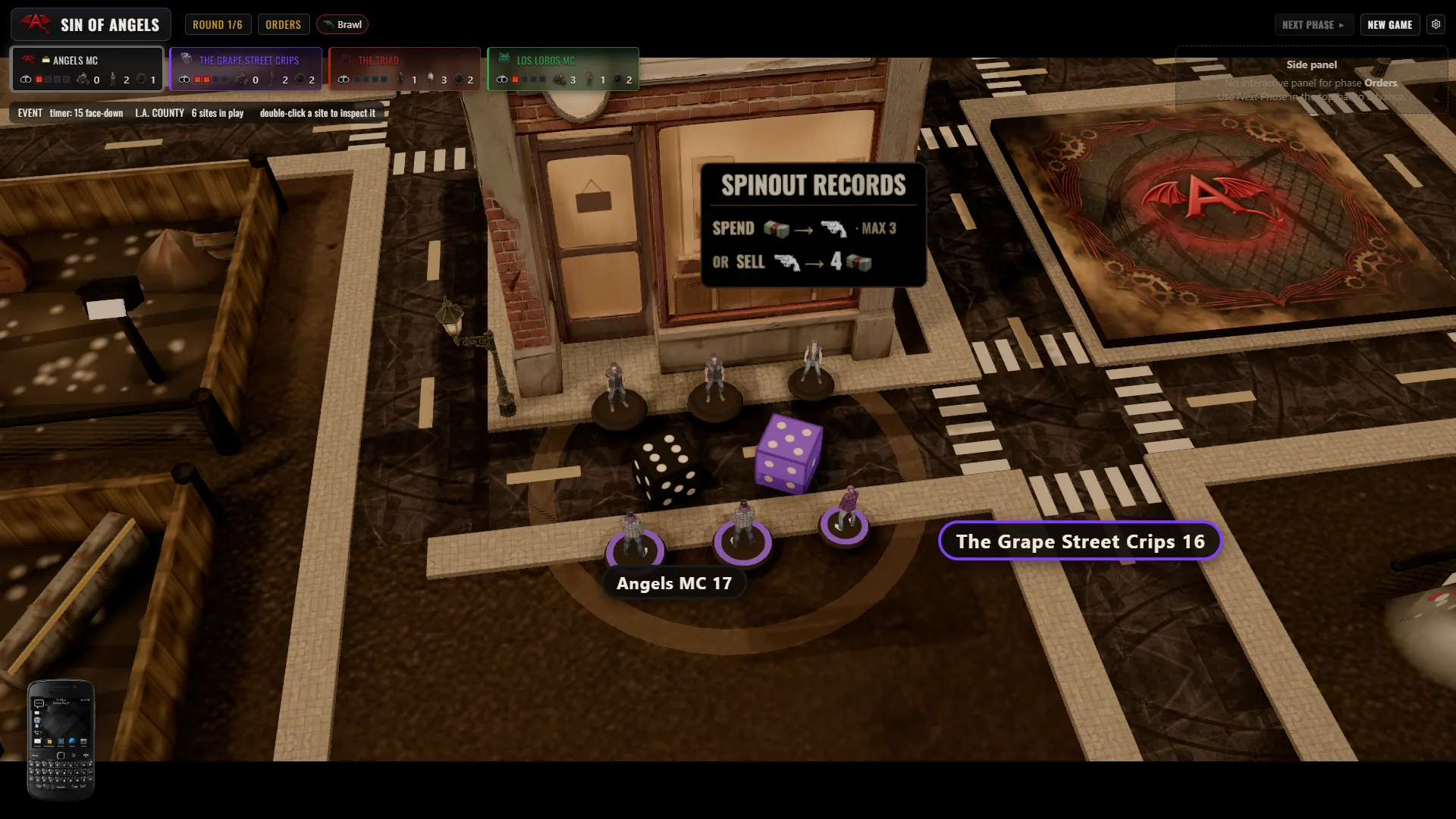
Couples who already know how to read each other's tells need a game that puts that skill to use instead of wasting it on chess. Sin of Angels is an outlaw motorcycle club digital strategy board game where the real contest is not the board, it is your partner's face across the table.
You run your own crew in a gritty L.A. County underworld. Once you're in, that means you:
- Bring in patched members and recruits to build your crew
- Muscle rival gangs off the streets
- Run guns and move narcotics
- Move onto the town's sites to use your crew for cash and weapons
- Settle disputes in the dirt
- Forge a ceasefire with your partner, then break it the second it benefits you
No install, ever. Sin of Angels is an independent, browser-based game with no license and no download. Once your beta spot opens, you and your partner are moving pieces within a minute of signing in.
Sons of Anarchy: Men of Mayhem seats 3 to 4 players around a physical board for about 90 minutes. It is a licensed tabletop game from Gale Force Nine, published in 2014, that ships in a box with a rulebook and setup.
Sin of Angels is an independent game, not affiliated with or endorsed by FX or the publishers of Sons of Anarchy.
Cinematic Brawl. When clubs clash on a site, it triggers a cinematic 3D Brawl. You watch the fight unfold instead of just reading a dice result.
Being browser-based with no installation required is what makes it a fit for a weeknight.
- It runs on desktop, tablet, or phone, straight in the browser.
- iPhone works right in the browser too.
- A native Android app is on the way.
- Sin of Angels is coming to Steam for PC players.
Once you are off the beta list, you play it your way. Share a couch and use local pass-and-play. Long-distance, run it as online multiplayer. Want an event? Fire up party mode: the 3D board goes on your TV, and you both use your own phones as controllers to plot moves in secret.
Want to practice before game night? Run solo against a smart AI opponent. One game takes about six rounds, so you can knock out a quick match or spend the whole evening fighting for the most cash on the board.
Join the Beta
Sin of Angels is in closed beta at soa-game.com. Get on the list and you play early, no install, and the bugs you report help shape what ships.
Related Guides
- Sin of Angels: The Outlaw Motorcycle Club Strategy Board Game
- The Best Games to Play Over Zoom With Friends
- The Best Games to Play Over Discord
- Virtual Game Night Ideas That Actually Work
Frequently Asked Questions
What games can a couple play together?
Look for titles built specifically for two players rather than large groups. Dedicated two-player board games, cooperative video games, and browser-based strategy games work best. You want mechanics that stay tight and competitive without needing a crowded table.
What are some good intimacy games for couples?
While many couples look for conversation starters or question decks, cooperative strategy games also build strong connections. Working together to beat a difficult digital board game requires heavy communication and trust. It forces you to operate as a single unit under pressure.
What games can two adults play?
Adults usually want games with deeper strategy, higher stakes, or mature themes. Heavy area-control board games, complex card duelers, and gritty digital strategy games fit the bill perfectly. You want mechanics that reward long-term planning and ruthless execution.
What are some good 2 player games for couples?
The best options depend on your hardware and time limits. For tabletop, look for tight card games or small-map board games that set up fast. For digital play, cooperative platformers or competitive browser-based strategy games offer instant setups and massive replayability.
Claim Your Turf
Finding the right game for two people changes your entire evening. Stop wrestling with massive rulebooks and games that need a crowd to function. Grab a title built for a head-to-head fight, claim your turf, and settle it in the dirt. Claim Your Spot in the Beta to see who rides out on top when your invite lands.
Sin of Angels is an independent game and is not affiliated with, sponsored by, endorsed by, or associated with FX, 20th Television, The Walt Disney Company, or the publishers of Sons of Anarchy or Sons of Anarchy: Men of Mayhem. All trademarks are the property of their respective owners.