Games Like Catan: The Best Strategy Board Games to Play Next
The best games like Catan swap dice-driven trading for something with more bite. Concordia and Scythe strip out the luck for pure strategy, 7 Wonders Duel and Targi handle head-to-head duels, and Sin of Angels moves the whole turf war onto a browser screen. Catan built the modern game night, but eventually you want higher stakes, sharper strategy, or just a new map to conquer.
Whether you need games like Catan for 2 players, heavier strategy games like Catan but better, or a digital board game you can throw on the TV, you have options. It is time to upgrade the table.
Key Takeaways
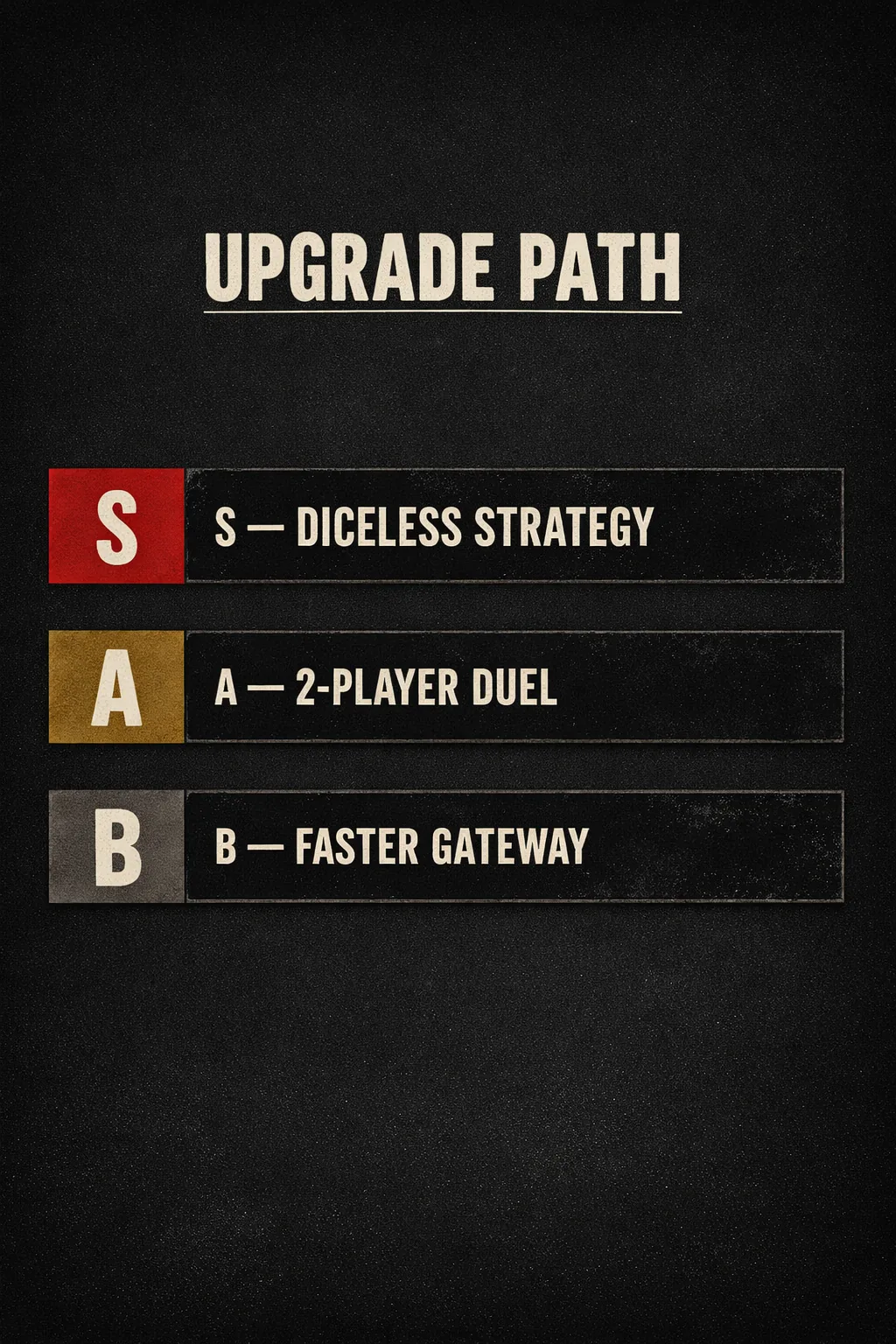
- Concordia and Scythe strip out dice luck for players who want pure strategy over random rolls.
- 7 Wonders Duel and Targi solve the two-player problem Catan cannot: a real head-to-head market.
- Carcassonne is the faster, easier-to-learn alternative if you want a lighter gateway game.
- Sin of Angels keeps the negotiation and betrayal but replaces hexes with turf you take by force.
- Run any pick through the Three-Question Test: headcount, luck tolerance, and physical vs digital format.
The Best Strategy Games to Play Next
When hunting for the best board games like Catan, you need to match the game to your group. Run this quick test before you scan the table below.

How to Pick: The Three-Question Test
- Headcount. Is your crew exactly two people, or three-plus? Two-player groups need a game built for a duel, not a trading market.
- Luck tolerance. Do you want dice removed entirely, or are you fine with some randomness if the stakes are higher?
- Format. Do you want a physical box on the table, or a digital game you can throw on a screen with zero setup?
Answer those three, then match your answers to the games below.
The Heavy Hitters
The Strategists. If your crew is tired of losing to bad dice rolls, you are looking for games like Catan but better. You want games that reward pure strategy.
Concordia takes the familiar loop of moving across a map and building resource engines. It removes the dice entirely. You play cards to take actions, you plan your turns, and you win because you outsmarted the table.
Scythe is another massive step up. It combines resource generation with cold war posturing. You build your engine, claim territory, and threaten your neighbors. It has the tension of a border dispute, but with higher stakes and complex interlocking mechanics.
The Two-Player Duels
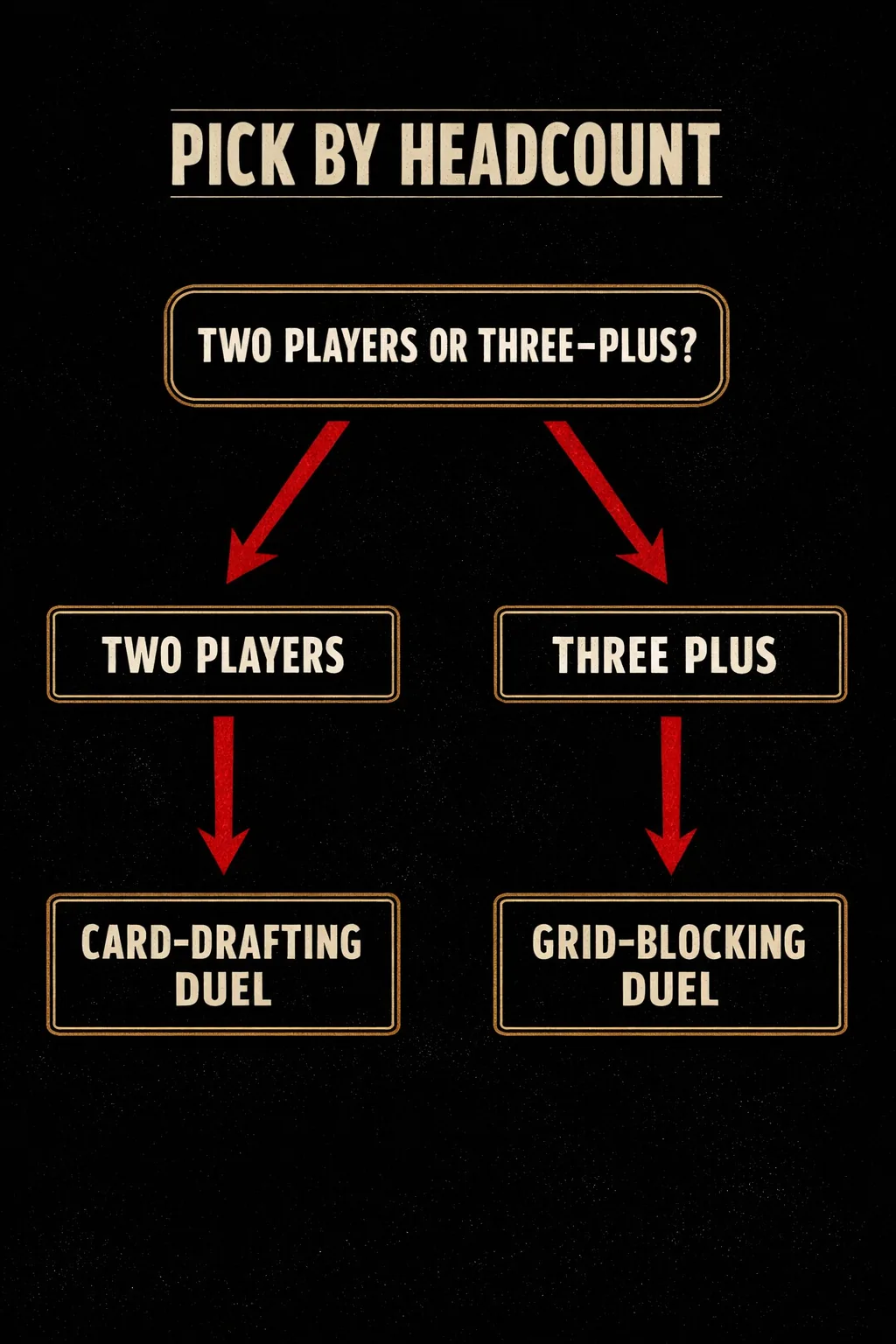
Finding games like Catan for 2 players requires a shift in rules, because the trading phase dies when only two people are at the table. You need games built for a head-to-head fight.
7 Wonders Duel is a masterpiece of drafting cards and denying resources to your opponent. Targi uses a grid of cards to simulate a tight, cutthroat market where every move blocks your rival. These games give you the economic puzzle without needing a third wheel to make a trade.
The Gateway Alternatives
If you need board games for people who like Catan but want a different flavor, look at the other modern classics. Carcassonne lets you build the map together, tile by tile. You fight for control of the cities and roads you create as you go. It is fast, aggressive, and easy to learn.
Pick your next guide based on what you want:
- Claiming routes and blocking your friends from crossing the country? Read our guide on games like ticket to ride.
- Ruining friendships over fake money and real estate? Read our guide on games like monopoly.
- Waging a massive war across a global map? Check out our guide on games like axis and allies.
| Game | Best For | What's Different From Catan | Players | Play Time | Complexity (/5) |
|---|---|---|---|---|---|
| Concordia | Crews tired of bad dice rolls who want pure strategy | Removes dice entirely; you play cards to plan your turns | 2-5 | 100 min | 2.99 |
| Scythe | Players who want higher stakes and complex engine-building | Adds cold war posturing and territory threats on top of resource generation | 1-5 | 115 min | 3.45 |
| 7 Wonders Duel | Head-to-head 2-player fights | Drafts cards and denies resources instead of trading with a third player | 2 | 30 min | 2.23 |
| Targi | Head-to-head 2-player fights | Uses a grid of cards to simulate a tight, cutthroat market | 2 | 60 min | 2.34 |
| Carcassonne | A faster, easier-to-learn gateway alternative | Builds the map together tile by tile instead of settling a fixed board | 2-5 | 30-45 min | 1.9 |
| Sin of Angels | Crews who want the negotiation and betrayal without the dice, in closed beta with zero setup once you're in | Replaces settling hexes with real sites you take and hold by force, no trading table required | 2-6 | one game night | Not BGG-rated |
The Anatomy of the Hustle: Why We Play
How Catan's trading, dice risk, robber, and slow endgame actually work
Before you can hunt down the best replacements, you have to understand what makes the original tick. It is not just about building roads. It is about who has the edge over who at the table.
When you sit down to play, you are looking at a blank map of hexes. Every tile produces something you need:
- Wood
- Brick
- Ore
- Wheat
- Sheep
But you never have enough of what you actually want. That is the trap. The game forces you to talk to the people sitting across from you. You have to negotiate. You have to hustle.
The Social Blood Sport. Players love Catan because it is a social blood sport disguised as a civilized game of settlement. You roll the dice and pray for your numbers to hit.
When they do, you get rich. When they do not, you starve. And when you starve, you have to beg your rivals for a trade.
The Turf War
At its heart, Catan is an area control game. You drop your first two settlements on the board, and the war begins. Space is tight.
Every road you build sends a message:
- It threatens someone else's plans.
- It claims territory.
- It cuts off their expansion.
- It boxes them into a corner so they cannot reach the ports.
This spatial puzzle is why games like Settlers of Catan stay on the table for years. You are not just managing a spreadsheet of resources. You are looking at a physical map and fighting over dirt.
If a rival takes the best ore tile, you have to find another way to get it:
- You build around them.
- You squeeze them out.
- You drop the robber on their best hex and choke their supply line.
People who look for Catan like games are usually chasing this exact feeling. They want a map. They want to claim turf. They want to look their friend in the eye and drop a piece of plastic right where that friend needed to go.
Sin of Angels runs that same turf fight on a real contested map, six rounds, most Cash wins. It's in closed beta now, so get on the list to try it. Claim Your Spot in the Beta
The Hustle and The Deal
You cannot win Catan in a vacuum. The dice will not let you. The resource distribution forces you to trade, and that is where the game actually happens: in the arguments over a piece of brick.
Negotiation is the engine of the game. You are constantly assessing who is winning, who is desperate, and who you can exploit.
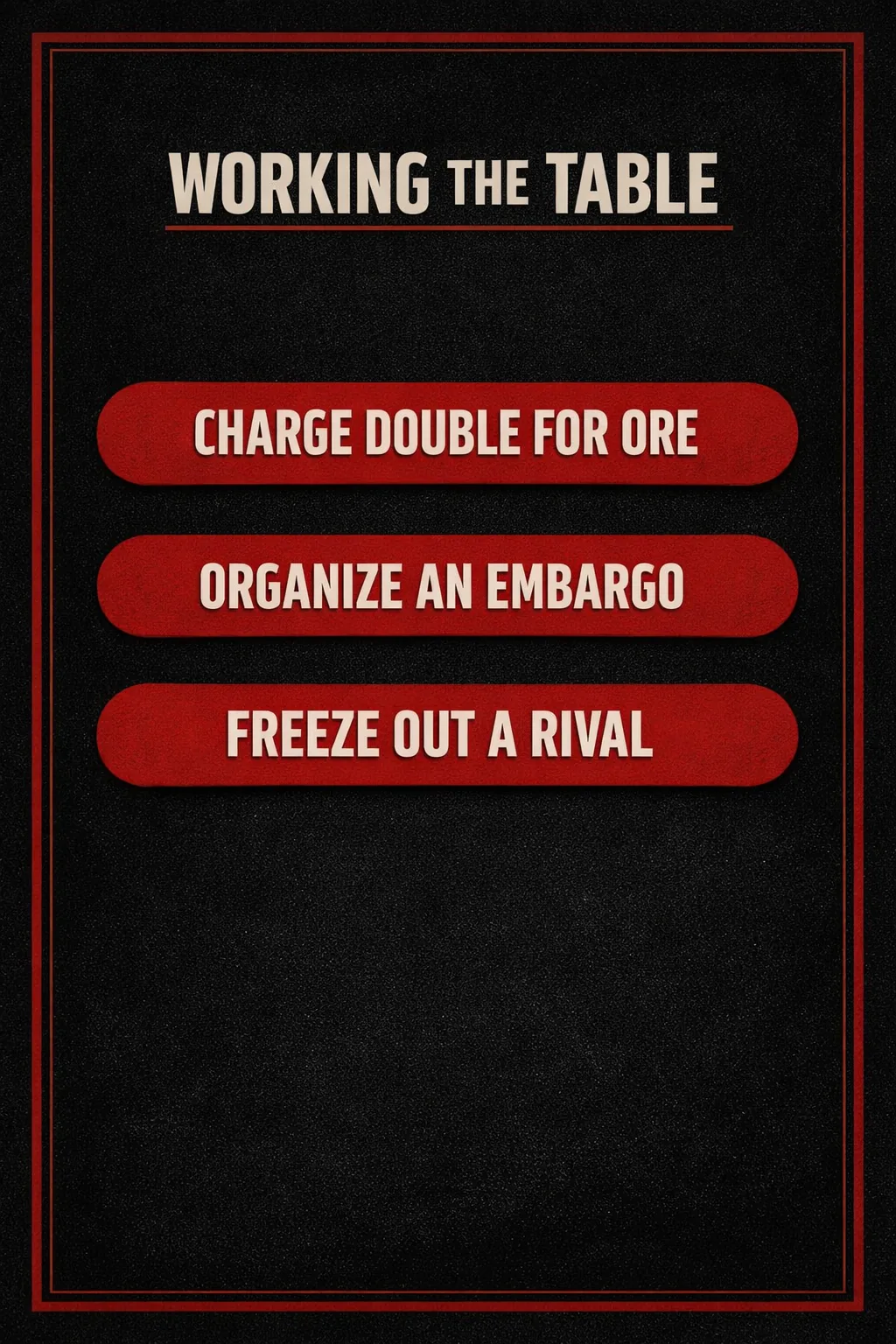
You work the table constantly:
- Charge double when someone needs ore to upgrade to a city.
- Organize an embargo against whoever is about to win the longest road.
- Convince the rest of the table to freeze out a threat.
This social dynamic is the hardest thing to replicate. When you search for board games for people who like Catan, you are looking for that table talk. You want a game that forces players to interact. Multiplayer solitaire does not cut it. You want deals, broken promises, and extortion.
The Element of Risk
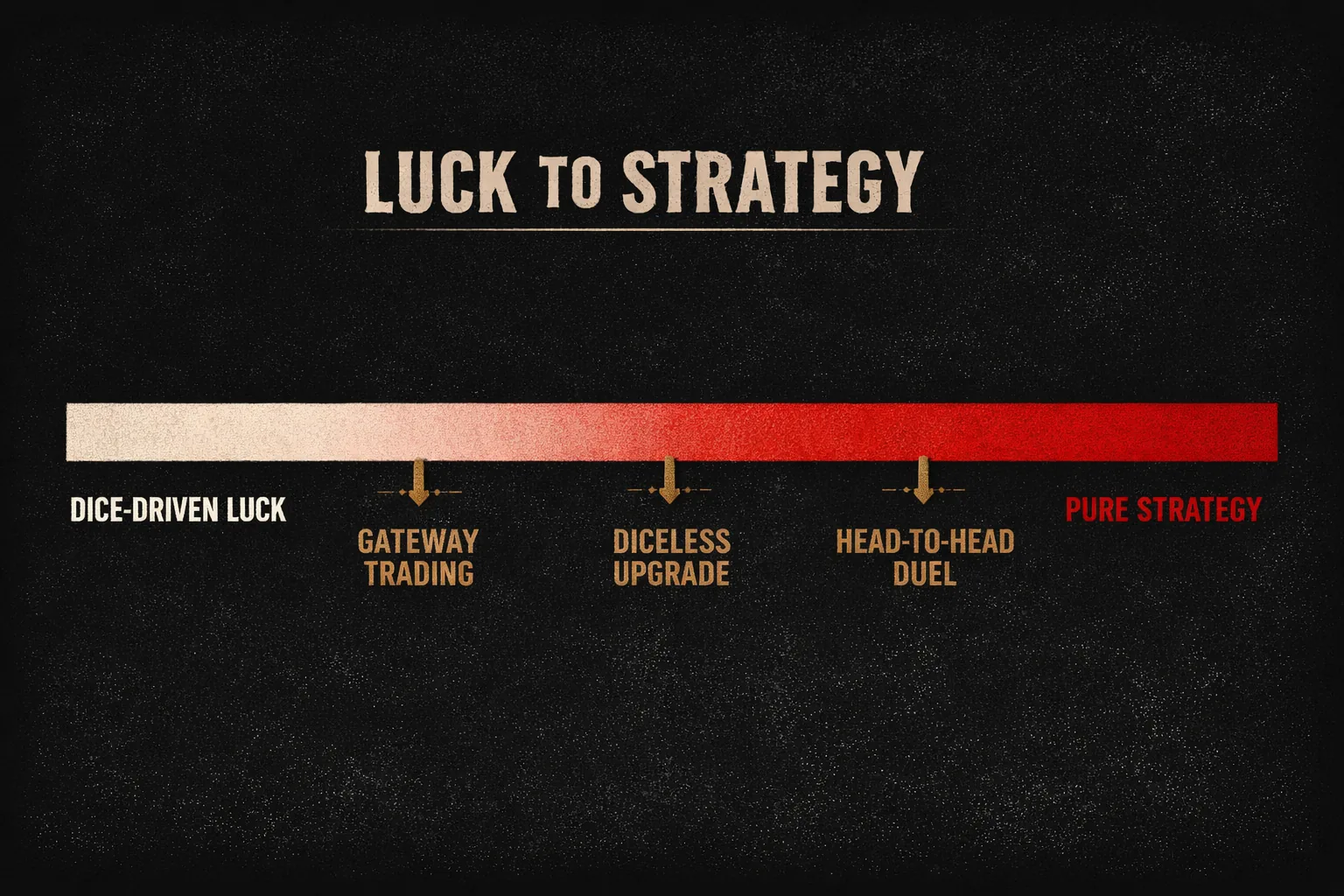
The Probability Trap. Two six-sided dice dictate the entire economy, and that is the risk you are signing up for. It is pure probability, but it never feels fair. You play the odds. You build on the sixes and the eights. You calculate the risk.
But the dice are ruthless. Sometimes the eights never roll. Sometimes the robber sits on your only brick tile for five turns. This creates massive tension. Every roll of the dice is a moment of shared anxiety.
This reliance on luck is also the main reason players eventually move on. After enough games, the dice start to feel like a cage.
The breaking point. You lose a game because your numbers went cold, not because you played poorly. That frustration sends players looking for games like Catan but better. They want the same resource management and the same map control, but they want their choices to matter more than a random roll.
The Threat of the Robber
The robber is the game's only direct weapon, and it turns on a single roll. Let us break down the anatomy of a turn. It starts with the roll. Everyone leans in. The dice hit the table, and the economy shifts. If a seven rolls, the tension spikes. The robber moves.
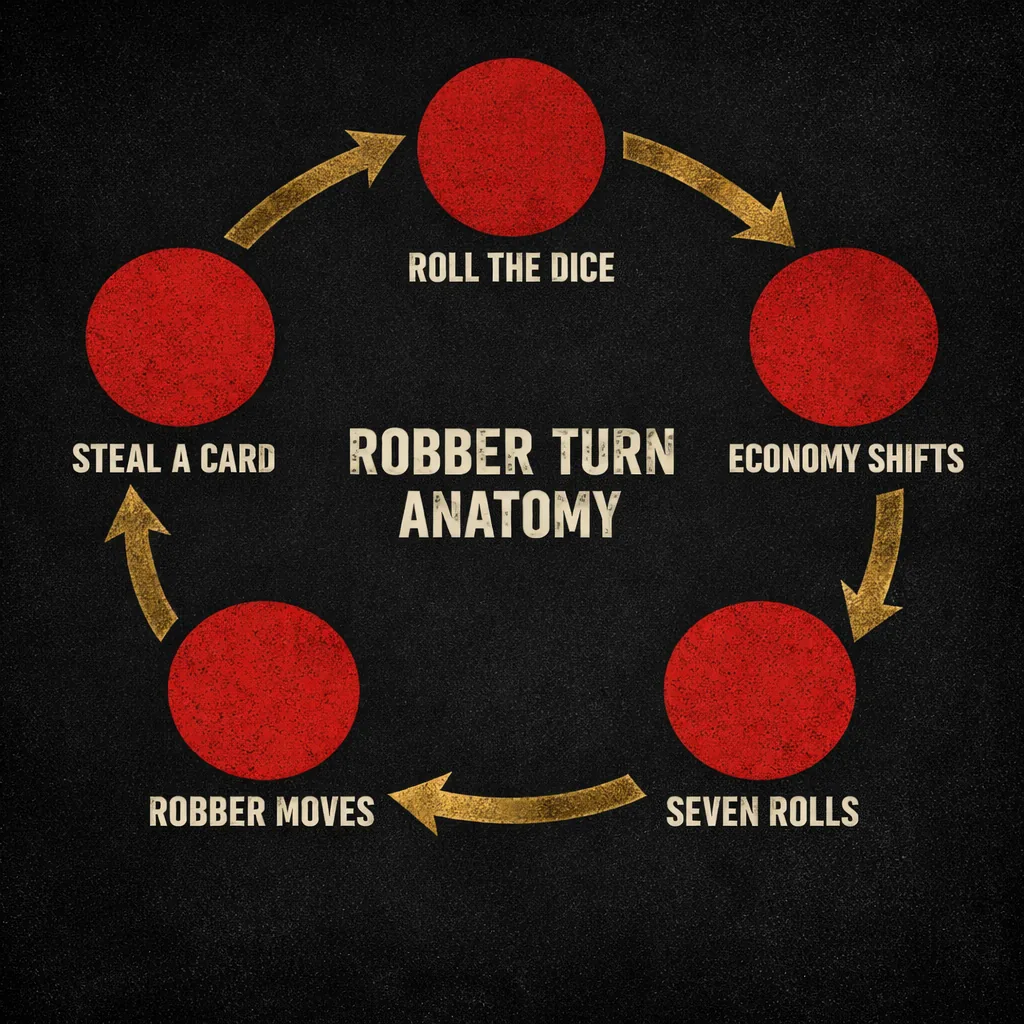
It is a blunt instrument. When you roll a seven, you get to shut down one hex on the board and steal a card from a rival. It sounds simple. It is actually a masterclass in table politics.
Where you place that wooden pawn sends a message:
- Do you hit the player in the lead?
- Do you hit the player who refused to trade with you last turn?
- Do you take a bribe to put it somewhere else?
This mechanic introduces direct conflict into an otherwise passive game of building. It forces you to make enemies. It creates grudges that last for hours.
When players ask for games for people who like Catan, they are often asking for this exact dynamic. They want a game that lets them reach across the table and punch a rival in the wallet. They want consequences.
The Cold War of Victory Points
You need ten points to win, but the real fight happens over two floating trophies. Building settlements and cities gets you most of the way there. The margins are won in the trenches of the Longest Road and the Largest Army.
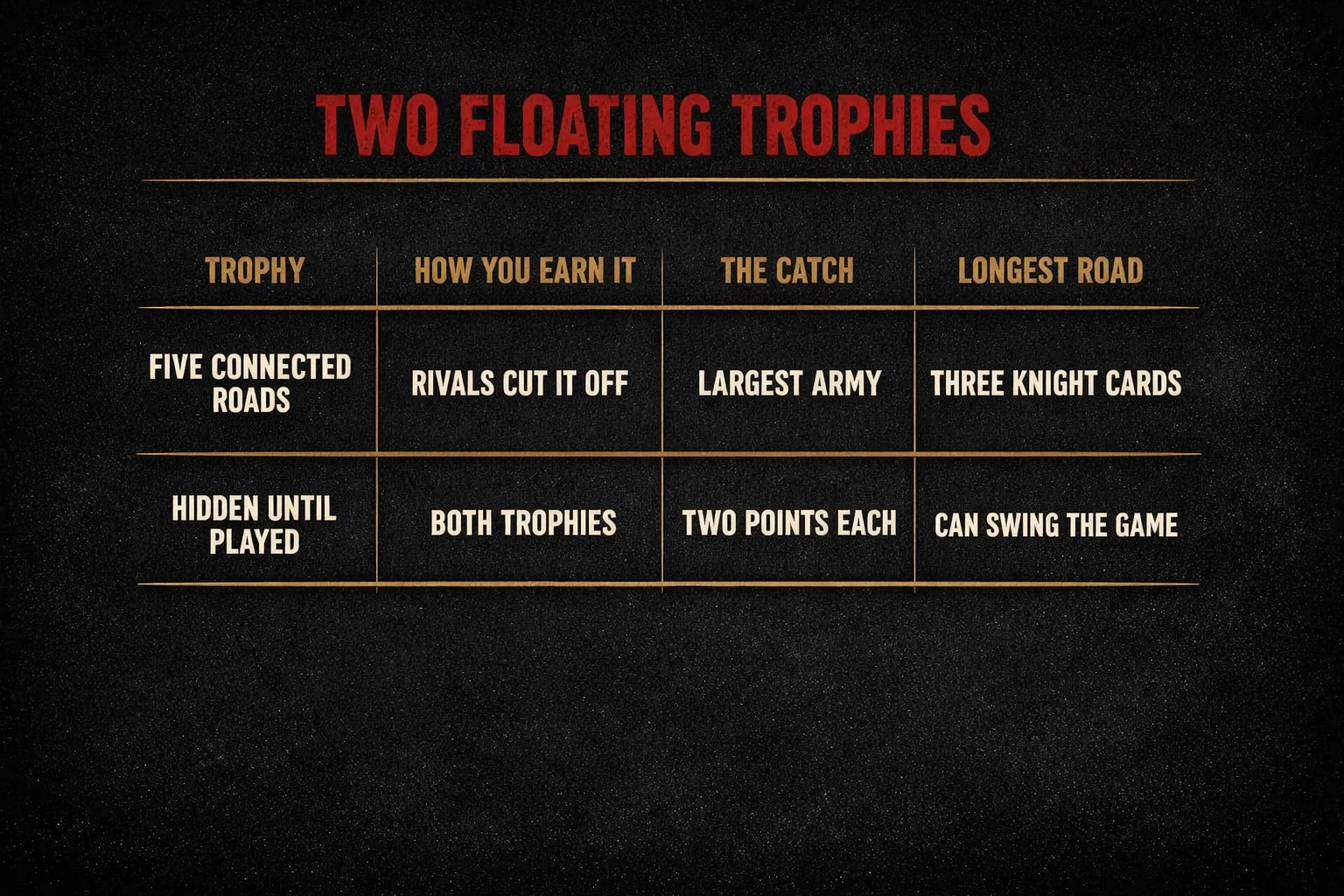
These are worth two points each, and they can swing a game in an instant. But they are never safe.
The Longest Road. It creates a cold war on the edges of the board. You watch your rival lay down two pieces of wood. You realize they are making a run for the title. You have to decide if you spend your own resources to cut them off, or if you let them have it and focus on your own engine. It is a constant calculation of risk and reward.
The Largest Army. It operates in the shadows. Players buy development cards and keep them hidden. You never know if that facedown card is a knight, a victory point, or a monopoly card waiting to gut the market. This hidden information keeps the table paranoid. You have to assume everyone is holding a weapon.
The Problem with the Endgame
The game's biggest flaw shows up late: the endgame often drags. If you get boxed in early, you spend the next hour rolling dice and passing your turn. You are a ghost at the table, with no territory to claim, no resources to trade, and no path to victory.
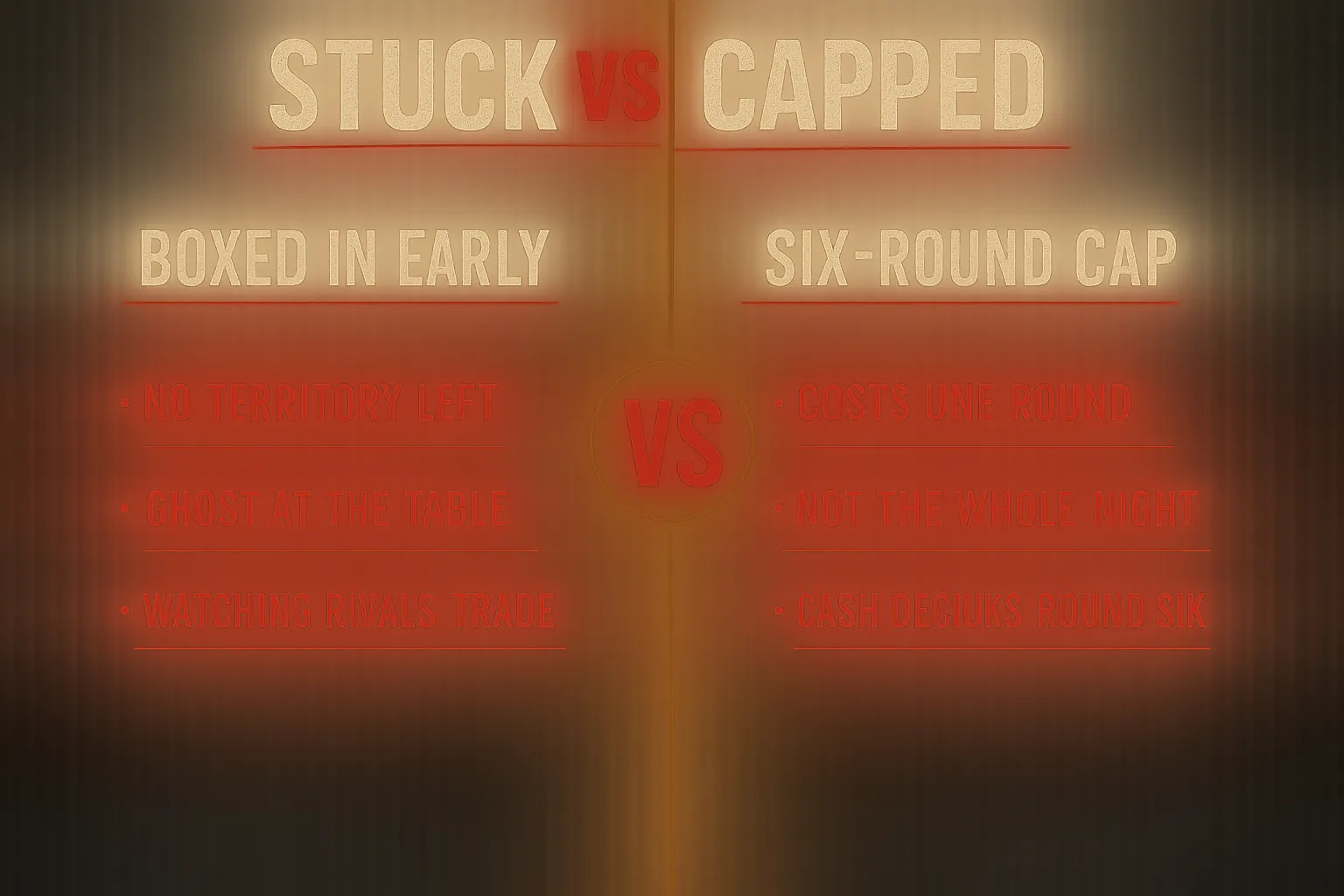
Stuck and starving. This player elimination without actual elimination is brutal. You sit there watching your friends cut deals while you starve.
The fix everyone wants. This is the breaking point for most groups. It is the moment you realize you need a game with catch-up mechanics, one where every player stays dangerous until the final round. Modern board games have solved this problem. They keep the tension high without locking players out of the fight.
Sin of Angels solves it a different way: exactly six rounds, and the win goes to whoever holds the most Cash at the end, so getting boxed in early costs you a round, not the whole night.
The Evolution of the Gateway Game
Catan is a gateway game. It introduces you to modern mechanics and teaches you that board games can be more than rolling a die and moving a top hat around a square track. It shows you what happens when players control the economy. But a gateway is meant to be walked through.
Once you see it, you cannot unsee it. Once you understand the mechanics of resource generation, you start seeing the matrix. You realize the luck of the draw is holding you back. You want more agency: an engine that runs on pure strategy, not just a lucky streak of eights.
The tabletop industry knows this. Designers have spent the last twenty years building games that take the Catan formula and strip it down for parts:
- They take the area control and add tactical combat.
- They take the trading and build massive, fluctuating black markets.
- They take the resource management and turn it into complex, interlocking puzzles.
Scaling the Conflict
Finding the right replacement depends on your crew's headcount. The original game is notoriously rigid. It demands exactly three or four players. Add a fifth, and the board gets too crowded. Drop down to two, and the game breaks entirely.
The trading economy requires a triangle of interests. With only two players, every trade that helps you hurts your opponent. There is no incentive to cut a deal. The market freezes.
The two-player problem. This is why finding games like Catan for 2 players is a specific hunt. You need a game designed from the ground up for head-to-head combat, with mechanics that simulate a market without a third human. You need a duel.
The other extreme. What if your crew is huge, six people ready to play? You need a game that scales up without dragging the playtime into the next morning. You need simultaneous turns, streamlined combat, or a digital platform that handles the math for you.
The Shift to Digital
Game night is changing because gathering around a physical table has real costs. It requires setup, teardown, and everyone being in the same zip code.
The modern game night is hybrid. Sometimes you are at the kitchen table. Sometimes you are on Discord. Sometimes you have a few friends on the couch, throwing a game up on the TV, while everyone else logs in from their phones.
Digital board games take the heavy lifting out of strategy:
- They track the resources.
- They enforce the rules.
- They handle the combat resolution in seconds.
You get all the betrayal, all the turf wars, and all the negotiation, but you get it faster.
What you actually want. When you look for the best board games like Catan, you are not just looking for cardboard anymore. You are looking for an experience that fits your crew's lifestyle, whether that means a massive physical box with plastic miniatures or a sleek browser game you can launch in ten seconds.
You want to claim the board. You want to run the economy. You want to win.
The games that follow deliver exactly that. They take the foundation of hexes and resources, and they build empires. They give you the tools to muscle your rivals out of the way. It is time to see what else is out there.
Sin of Angels: The Digital Turf War
How Sin of Angels' turf-taking, betrayal, and beta platform actually work
Trade sheep and wheat long enough and you start wanting a table where the deals have real teeth. Sin of Angels keeps the negotiation that made Catan work and swaps the dice-dependent hexes for turf you actually take by force. If you are looking for catan like games that deliver ruthless negotiation and brutal area control, step into the L.A. County underworld.
Sin of Angels is our outlaw-MC strategy board game. It takes the core tension of claiming turf and cutting deals. Then it hands you the keys to a motorcycle club.
Building Your Crew. You start by building your crew. You bring in patched members and recruits. Then you hit the streets. You move your bikers onto the town's sites.
You claim the sites to run the economy:
- The dive bars
- The Iron Works
- San Pedro Docks
- The Picket Fence Lab
You use these locations for cash, guns, and narcotics. You run the economy by trading on The Silk Road and managing your felonies with the law.
The negotiation is completely open. You cut deals with rival gangs.
Betrayal is built in. You forge ceasefires to take down a mutual enemy. Then, when the time is right, you break those deals and bleed them dry.
When two clubs clash on a site, it is a brawl. Instead of just rolling dice and doing math, the game resolves the fight with cinematic 3D battles. You win by holding the most Cash when Round 6 ends.
Digital, No Setup
This is a digital board game built for the modern game night. There is no setup and no teardown. It is entirely browser-based.
It's built to play wherever you are:
- Desktop, tablet, or phone, all in the browser.
- iPhone works right now, no install required.
- A native Android app is on the way.
- PC access via Steam is planned.
Once beta access opens up, you play it your way:
- Run a solo campaign against a smart AI opponent.
- Jump into online multiplayer with friends across different devices.
- Pass and play on a single screen.
- Run party mode: throw the 3D board up on a TV, and everyone in the room plays secretly from their own phones.
One game takes about six rounds. It is the perfect fit for a full game night or a quick, violent match.
Join the Beta
Sin of Angels is in closed beta. Get on the list and you play early, and the bugs you report shape what ships.
Related Guides
- Sin of Angels: The Outlaw Motorcycle Club Strategy Board Game
- Games Like Monopoly (But With Real Strategy)
- Games Like Ticket to Ride: Strategy Picks for the Whole Group
- Games Like Axis and Allies: Conquest and Wargame Alternatives
Frequently Asked Questions
What games are similar to Catan?
Games that share the mechanics of resource management, trading, and area control are the closest matches. Concordia and Scythe offer deeper strategy with less luck. Carcassonne and Ticket to Ride provide similar gateway experiences with a focus on claiming territory and routes.
What are the top 3 board games of all time?
Rankings change constantly based on player votes on major database sites. Heavy strategy games like Brass: Birmingham, Pandemic Legacy, and Gloomhaven frequently hold the highest spots. These games offer deep campaigns, complex economies, and intense cooperative or competitive play.
What is the #1 board game in the world?
Brass: Birmingham currently holds the top spot on many major community ranking sites. It is a heavy economic strategy game about the industrial revolution. For casual audiences, classic games like Monopoly or Chess remain the most widely recognized and played globally.
Which is better, Catan or Carcassonne?
It depends entirely on your group. Catan is better if you want loud negotiation, trading, and direct player interaction. Carcassonne is better if you prefer a faster pace, a puzzle-like tile placement system, and zero reliance on dice for resource generation.
What is the best board game for people who like Catan?
Concordia is widely considered the best step up for fans of resource generation and map expansion. It replaces the random dice rolls with a strategic card system. This gives players total control over their economy while maintaining the fierce competition for territory.
Claim Your Turf
The table is waiting. Whether you want to dominate a cardboard map or run guns in a digital underworld, it is time to make your move. Get on the beta list, gather your crew, and get ready to ride out on top.