
The Best Games to Play With a Big Group

The best games to play with a big group are social deduction titles like Secret Hitler for paranoia and fast arguments, area-control heavyweights like Blood Rage or Rising Sun for brutal combat, Jackbox-style screen-and-phone games for zero-setup party play, and Sin of Angels for heavy strategy with a browser link instead of a rulebook.
Nobody wants a rulebook at a party. You cannot just drop a heavy strategy manual on the table and expect everyone to read it. You need something that gets the whole room involved immediately. No long rulebooks, no waiting twenty minutes for a single turn. You want action, alliances, and a reason to talk trash across the room.
Hosting a massive game night is a specific skill. You are managing a crowd. If a game takes too long to set up, you lose them. If a player gets knocked out in the first ten minutes, they spend the rest of the night scrolling on their phone.
The best games to play with a big group of friends solve these problems before they start. They keep the friction low and the engagement high. Whether you're at a local dive or running things online with a scattered crew, the fundamentals stay the same:
- You need mechanics that scale.
- You need a setup that makes sense.
- You need a game that lets you cut deals, break them, and settle the score.
Key Takeaways
- Party games for a crowd survive on simultaneous action, not one long turn per player.
- Skip player elimination. Everyone needs a reason to stay at the table until the end.
- Browser and screen-and-phone games remove setup friction, both locally and remote.
- Shared territory forces negotiation, and letting players break deals makes a night memorable.
- Sin of Angels combines heavy-strategy depth with a browser link instead of a rulebook.
Reliable Picks for a Crowded Room
When you need large group party games, you have a few reliable routes:

- Social deduction games like Secret Hitler or Two Rooms and a Boom handle massive player counts. They thrive on paranoia and fast arguments.
- Pure area-control strategy: tabletop heavyweights like Blood Rage or Rising Sun push players into brutal combat and broken deals.
- Screen-and-phone setups: Jackbox Games built the blueprint for throwing a party on the TV.
- Browser-based area-control: Sin of Angels brings that same brutal combat and broken deals to a screen instead of a box, though it is in closed beta now with no physical components if your group wants something for the table.
But if your crew wants the depth of a heavy strategy board game with the ease of a digital link, you need something built specifically for that gap. You need a game that combines the ruthless negotiation of a tabletop classic with the zero-friction setup of a browser game.

Run any pick through the Three-Question Test before you commit to it for game night:
- How long is setup? A rules-heavy box eats twenty minutes before anyone plays. A browser game is a link in the chat.
- Does anyone get eliminated? Getting knocked out early kills a big group night fast. Staying in the fight until the end keeps people at the table.
- Does it scale past your living room? A physical-only game needs everyone in the same room. A remote-friendly game does not.
Score any row in the table below against those three questions and you will know fast whether it fits your crowd.
| Game | Type | Setup | Best For |
|---|---|---|---|
| Secret Hitler / Two Rooms and a Boom | Social deduction | Physical, quick to teach | Paranoia and fast arguments |
| Blood Rage / Rising Sun | Tabletop area-control (Blood Rage: 2-4 players, 60-90 min, complexity 2.88/5) | Heavy box, full table | Brutal combat and broken deals |
| Jackbox Games | Screen-and-phone | TV plus phones as controllers | Throwing a party on the TV |
| Sin of Angels | Browser-based area-control (2-6 players, about 6 rounds) | Zero install, drop a link | Heavy-strategy depth with digital ease, party mode or solo |
The Reality of Hosting a Massive Game Night
Explains why turn-based games stall past four players, using the math of an eight-player, three-minute-turn game.
Push past four players and the whole dynamic of a game night changes. Four players is a tight circle. Six is a crowd. Eight or more is a mob.

Most traditional board games break down under that much weight. The math does not work. If a turn takes three minutes, an eight-player game means waiting twenty-four minutes between your moves. That is a death sentence for any gathering.
Big group party games survive by changing that math. They rely on simultaneous action, quick decisions, and constant cross-talk.
If you are looking for games for big groups of adults, prioritize the social element first. The mechanics are just an excuse to argue, negotiate, and betray the people sitting next to you.
Physical space matters too. If you are searching for games to play inside with a big group, a table big enough for a massive board, hundreds of tokens, and eight player mats may not exist in your house.
You need a footprint that fits the room. That is why digital adaptations and screen-based games have taken over the large-group scene. They handle the heavy lifting so you can focus on the fight.
Setup Friction: The Game Killer
Explains why long rules explanations kill party momentum and mentions Sin of Angels' closed-beta shortcut.
Nothing kills the momentum of a party faster than a thirty-minute rules explanation. You open the box. You start sorting decks of cards. You hand out plastic pieces. By the time you explain the victory conditions, half the room has stopped listening.
Put the complexity in the strategy, not the rules. Large group party games need to hit the ground running. You want a game you can teach in three minutes. You explain the basic loop, tell them how to win, and let them figure out the tactics as they play.
Setup friction also includes the physical teardown. When the night is over, no one wants to spend twenty minutes bagging up tiny wooden cubes. Digital board games eliminate this problem completely. The computer shuffles the cards, tracks the score, and handles the math when a fight breaks out. You just log in and start claiming territory.
Sin of Angels skips the teardown entirely: it is in closed beta now, and beta players get the whole crew in the browser in minutes. Join the Beta
Surviving the Rules Explanation
Tips for pitching a game's theme and splitting the room into factions instead of reading a rulebook aloud.
Teaching a game to ten people requires crowd control. You cannot read from a rulebook. You have to pitch the concept. You sell the theme first. You tell them who they are and what they are trying to do.
Split the room into factions first. If you are running team building games for large groups, give people a team immediately. A team gives them a focus. They do not need to understand every rule right away, just how to help their crew.
The smartest games handle the tutorial dynamically. They restrict your choices on the first turn so you cannot make a catastrophic mistake. They give you clear, immediate goals. Once the players see the results of their first action, the mechanics click into place. From there, the training wheels come off, and the real game begins.
The Problem with Player Elimination
Argues elimination kills long games and describes keeping losing players seated via territory loss, not ejection.
Player elimination is the fastest way to kill a game night. It might work fine in a short, ten-minute round. It is a disaster in a three-hour game, especially if someone can die in the first fifteen minutes. Player elimination is a relic of older game designs.

Keep everyone in the fight. Party games for large groups need to keep everyone in until the bitter end. Even if a player is losing, they need a reason to stay at the table. They need the ability to play kingmaker. They need the power to cut a deal, fund a rival, or throw a wrench into the leader's plans.
A good game keeps the tension high without forcing anyone to sit on the sidelines. If you take a hit, you lose territory or resources, but you keep your seat at the table.
You rebuild your crew. You wait for the right moment to strike back. The threat of violence is always better than actually removing someone from the room.
Remote Play and Digital Solutions
Covers remote-session logistics and links to the Zoom, Discord, and virtual game night guides.
Sometimes the crew cannot make it to the same house. People move. Schedules clash. You still want to play, but you have to do it through a screen. Remote-friendliness is no longer an optional feature for a modern game night. It is a requirement.
Setup friction looks different online. You cannot ask eight people to buy a thirty-dollar app or install heavy software and create complex accounts. You need a game that runs in a browser. Drop a link in the chat, they click it, and they are in.
This is where browser-based strategy games dominate. They require zero installation. They work on a desktop, a tablet, or a phone. If you are setting up a remote session, you want the technology to be invisible. You run the voice chat through your preferred app, and you let the browser handle the board.
If you need help setting up the communication side, check out:
The goal is to replicate the feeling of sitting around a table. You want to hear the groan when someone breaks a ceasefire. You want to see the chat light up when a massive fight breaks out over a key piece of turf. For more ways to structure an online session, read through our guide on virtual game night ideas.
That "still has a seat, still has a reason to fight" design is exactly why Sin of Angels never knocks a player out before round six, wherever your crew is logging in from.
The Power of the Screen-and-Phone Setup
Details how TV-plus-phone formats like Jackbox keep secret info on phones while the TV resolves public actions.
The biggest revolution in local game nights is the Jackbox-style party format. You put the main game board on the television. Everyone in the room uses their own phone as their controller.

It solves almost every large-group problem at once. You do not need a massive table. You do not need to buy extra controllers. Everyone already has a phone in their pocket. The television acts as the public focal point. It shows the map, the score, and the cinematic moments.
The phones handle the secret information. This is crucial for strategy and betrayal. You can look at your hand of cards without anyone seeing. You can lock in your orders in secret. You can send a private message to another player to coordinate an attack.
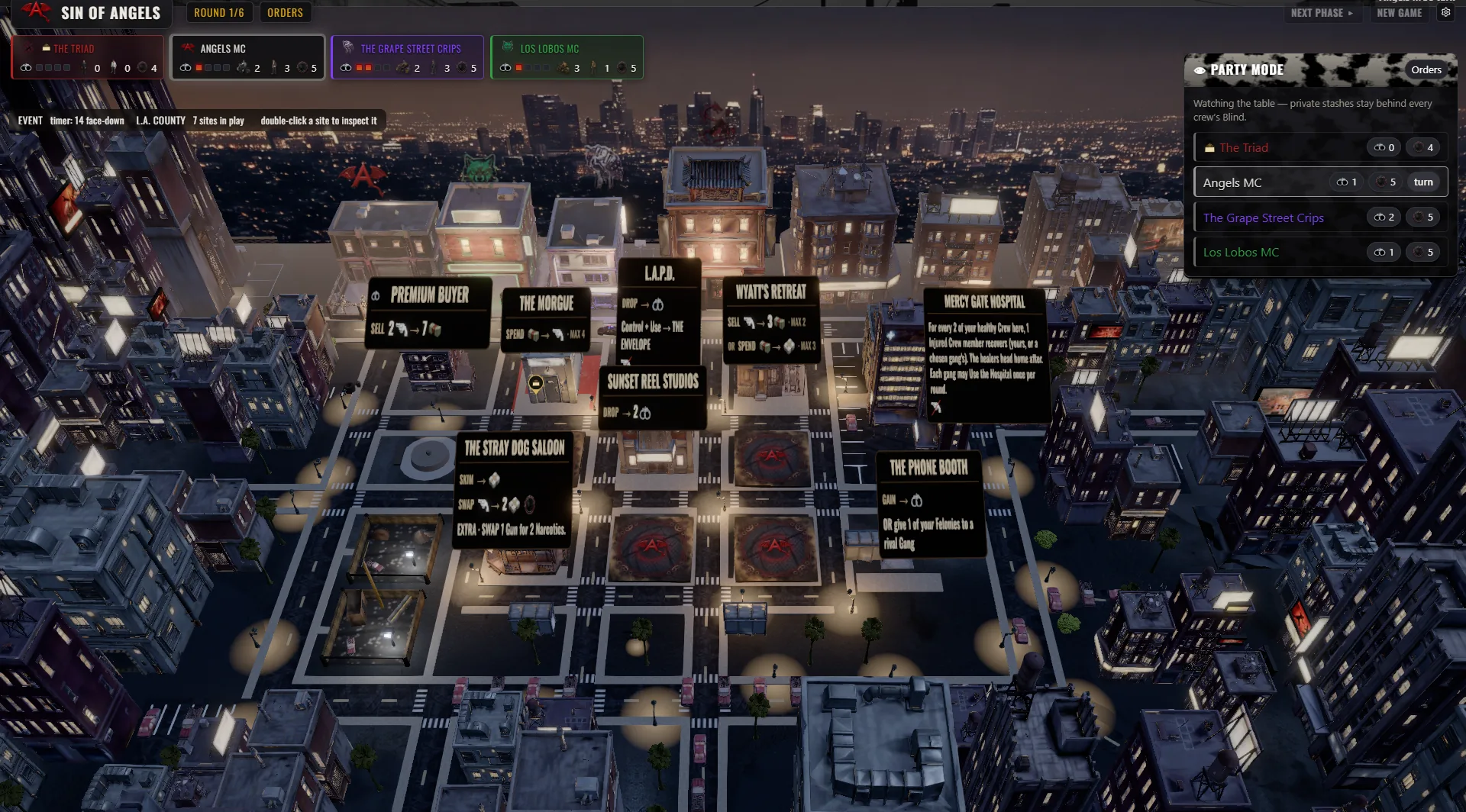
When all the orders are locked, the television resolves the action for the whole room to see.
Digital convenience meets physical presence. You get the loud, chaotic energy of a living room party, backed by the smooth execution of a digital engine.
The Social Element: Deals, Betrayal, and Trash Talk
Explains why shared territory and breakable alliances make betrayal the ingredient of a memorable game night.
The mechanics of a game only take you so far. The real magic of a large group game happens above the table. You want a game that forces interaction.

Shared territory forces the issue. If everyone is just staring at their own cards and optimizing their own score, you are not playing a group game. You are just playing solitaire in the same room. You need a game with shared territory and a map too small for everyone to survive peacefully.
When resources are tight, players have to talk. They have to negotiate. They have to form alliances to take down the current leader. A good game provides the tools for these negotiations: trade cash, offer backup in a fight, or promise safe passage.
More importantly, a great game lets you break those promises. The moment a ceasefire shatters is the moment a game night becomes memorable.
The betrayal has to sting. You want mechanics that reward loyalty but tempt betrayal. You want a system where a well-timed knife in the back can swing the balance of power. That is how you keep ten people engaged: give them a reason to watch their own backs.
Sin of Angels: Strategy on the Big Screen
Pitches Sin of Angels in detail — recruiting, territory, deal-breaking, and the six-round Cash-based Brawl scoring.
Ten people, one table, zero patience for a rulebook: that is the exact problem our outlaw-MC strategy board game was designed to solve. Sin of Angels is a turn-based area-control game about running an outlaw motorcycle club in a gritty California underworld. Running the club comes down to three things:
- You muscle rival gangs off the streets.
- You run guns and narcotics.
- You bleed the town dry.
Zero install, zero hassle. It solves the big-group problem by stripping out the setup friction. It is a browser-based game with no install, built to play online with friends across any device, including your iPhone.
A native Android app is on the way, and Sin of Angels is coming to Steam for PC. It is in closed beta now: get on the list and you will be dropping a link in the chat instead of a rulebook.
If you are all in the same room, you fire up party mode. The 3D board goes on the TV, and everyone locks in their orders from their own phones. The game handles the math. You handle the betrayal.
Recruit, expand, and cut deals. Sin of Angels breaks that down into three moves:
- You bring in patched members and recruits.
- You take territory and use sites like The Iron Works and the Picket Fence Lab.
- You cut deals with rival clubs on The Silk Road, and you break those deals when the time is right.
When clubs clash on a site, it is not just a dice roll. The game throws you into a cinematic 3D Brawl. Fight for territory over six rounds to build the biggest pile of Cash, and whoever has the most Cash when the game ends wins the town.

It gives you the weight of a heavy strategy game without the thirty-minute rules lecture. You can also play solo against a smart AI opponent to test your strategies before the rest of the crew logs on.
Join the Beta
Sin of Angels is in closed beta at soa-game.com. Get on the list, and beta players get in first and help shape the finished game.
Related Guides
- Sin of Angels: The Outlaw Motorcycle Club Strategy Board Game
- The Best Games to Play Over Zoom With Friends
- The Best Games to Play Over Discord
- Virtual Game Night Ideas That Actually Work
Frequently Asked Questions
What games can you play with 9 people?
With nine players, you need games that support simultaneous action or team mechanics. Social deduction games and Jackbox-style digital party games excel here. They keep everyone engaged without forcing players to wait twenty minutes for their turn.
What's a fun activity for a large group of friends?
Hosting a digital board game night on a television is one of the best ways to manage a large group. Everyone uses their own phone to play. It keeps the room loud and interactive while the computer handles the heavy lifting.
What to play in big groups?
Focus on games that prioritize negotiation, alliances, and quick turns. Area-control games where players fight over shared territory force interaction. Avoid games with long setup times or early player elimination.
What is a good game for 10 people?
For ten people, browser-based party games and social deduction games are your best options. They require zero physical setup and scale well with high player counts. The mechanics stay simple so the focus remains on the social interaction.
What is a fun game to play with a large group?
The most fun games for a massive group involve hidden information and betrayal. Games that let you cut deals in secret and stab your friends in the back always create memorable nights. Screen-and-phone games make this easy by keeping your hand of cards hidden on your personal device.
Settle It in the Dirt
Getting a massive group together is hard enough. Do not ruin the night with a game that takes an hour to set up. Get on the beta list now, and Sin of Angels is ready for the big screen and your phones when your invite lands.