
Online Tabletop Games: The Best Ways to Play Remotely

Online tabletop games split into three types: a 3D physics sandbox where you move pieces yourself, an automated rules engine that handles the math, or a ready-made digital board game built for a screen. Picking an online tabletop game means picking one of these three.
Key Takeaways
- 3D sandboxes give total customization, but you police the rules yourself and setup takes time.
- Automated rules engines enforce every move and speed up play, at the cost of the tactile dice-rolling feel.
- Ready-made digital games like Sin of Angels have the lowest barrier to entry: no sandbox to wrestle, no rulebook to enforce.
- Browser-based platforms level the hardware gap since they run on desktop, tablet, and phone alike.
- Voice chat or a group call keeps the social negotiation alive once the board moves online.
Which one wins depends on your group. Weigh these before you commit:
- How much setup patience your crew has
- What devices everyone actually owns
- Whether you want free classic board games or a premium title
Moving game night online changes the dynamic. You lose the physical table, but you gain real convenience. Nobody has to drive. Nobody has to clean up. You just log in and start cutting deals.
The catch is coordination. Getting everyone into the same lobby takes a platform that works for the hardware your friends actually own.
The best online tabletop games remove that friction. They let you focus on strategy, alliances, and the inevitable betrayals. Here's how the three types break down. Then we'll cover what it costs to play, and how to pick the setup that fits your group.
The Three Ways to Play Tabletop Games Online
The digital tabletop space splits into three distinct categories. Each one serves a different kind of player. You've got sandboxes, rules hubs, and dedicated games.

| Type | How It Works | Best For | Trade-Off |
|---|---|---|---|
| 3D Physics Sandbox | Players move pieces manually; a physics engine handles the table, not the rules | Tabletop RPGs and custom maps or minis | Clunky controls, more setup time |
| Automated Rules Engine | Code enforces the rules and calculates scores automatically | Classic board games online | Faster play, but you lose the tactile feel of physical dice |
| Ready-Made Digital Board Game | Rules are hard-coded with a custom UI, animations, and sound | Solo AI play or friends across the country | Low barrier to entry, no physics engine to wrestle |
Use the Control-to-Spectacle Spectrum to pick fast. The three types sit on one line, moving from the most player control to the most built-in production value:

- Want total customization and don't mind managing the board yourself? Pick a sandbox.
- Want real rules enforcement and fast play? Pick a rules engine.
- Want zero setup and the most polish? Pick a ready-made game.

Move down that list and you trade manual control for convenience.

3D Physics Sandboxes
A sandbox platform gives you a virtual table and a box of parts: cards, dice, tokens, and a physics engine. You log in, load a module, and sit down at the digital table.
These platforms don't enforce the rules. Players have to police the board themselves:
- Want to move a piece? Click and drag it.
- Need to shuffle a deck? Hit a button to randomize the stack.
- Someone makes an illegal move? The game won't stop them.
Sandboxes offer massive flexibility. You can play almost anything. That's why they're popular for tabletop RPGs online, since a game master can drop in custom maps and miniatures.
But the freedom comes with a cost. Controls can feel clunky, and moving dozens of tiny tokens with a mouse takes getting used to. Setup takes time too, since you're simulating the physical chore of managing a board.
Automated Rules Engines
If you want the computer to do the heavy lifting, look for a rules engine. These are usually browser-based hubs that host massive libraries of games.
In an automated engine, the code enforces the rules. You cannot make an illegal move. The system also handles:
- Calculating scores
- Managing setup
- Tracking the phases of each turn
This speeds up play significantly. You don't have to argue over rulebook edge cases; the system knows the math.
These platforms are excellent for classic board games online. You log in, invite your friends, and the game handles the rest. The interface is usually flat and functional, more like a top-down 2D map.
The tactile tradeoff. You lose the tactile feeling of rolling physical dice, but you gain speed. A game that takes two hours in person might take forty-five minutes on an automated platform. If you want to explore this category further, check out our guide on board game arena alternative options.
Ready-Made Digital Board Games
The final category is the standalone digital board game. These aren't modules inside a larger hub. They're individual games built from the ground up to run on a screen.
A dedicated app or browser game gives you a purpose-built experience. The developers build a custom user interface for that specific title. They add animations, sound effects, and music. When a fight breaks out, you might see a cinematic battle instead of just a static dice roll. The rules are hard-coded into the system.
These games often include modes you can't get on a physical table:
- Play with friends across the country
- Play solo against an AI opponent
The barrier to entry is low. You don't have to teach the rules to a computer or wrestle with a physics engine. You just load the game and play.
That is exactly the category Sin of Angels lives in. No sandbox to wrestle, no rulebook to enforce yourself, just the fight. The game is in closed beta now: Join the Beta and you play early, plus the bugs you report shape what ships.
Platforms, Devices, and the Cost of Entry
Compares Steam ownership rules, browser cross-device access, and mobile's screen limits.
Getting your crew together means finding a game everyone can actually run. Hardware fragmentation kills game nights. If half your group is on PC and the other half only has phones, your options narrow fast.

Steam and PC Gaming
Steam is the heavyweight platform for digital tabletops. Most sandboxes and premium standalone games live here. If you want high-end graphics and deep physics simulations, you'll likely need a PC.
Games on Steam are usually one-time purchases. You buy it, you own it. But the ownership rules vary by title:
- Sometimes only the host needs to own the game, and friends can join for free.
- Other times, every player needs their own copy.
If your entire group has gaming PCs, Steam offers a massive catalog. You can read more in our guide on board games on steam.
Browser-Based Platforms
Browser games bypass the app stores entirely. You don't need to download a client. You don't need to install updates. You just click a link and join the lobby.
The big advantage is accessibility. A browser game runs on a desktop, a laptop, a tablet, or a phone. It levels the playing field for groups with different hardware, since many automated rules hubs operate entirely in the browser.
Pricing here usually relies on subscriptions or freemium models:
- Free online multiplayer board games are common.
- Premium titles might require a paid membership, but usually only the host needs it. Everyone else joins free.
If you're looking into the costs of these hubs, read our guide on is board game arena free.
Mobile Support
Mobile support is the wildcard. Dedicated apps exist for many popular games, but cross-platform play is not guaranteed. Sometimes the mobile app only connects to other mobile users.
Screen real estate is the biggest challenge for mobile. A complex strategy game with a massive board is hard to read on a phone. The best mobile adaptations redesign the interface completely, using collapsible menus and zoom functions. If you want to play on the go, look for games that explicitly support mobile browsers or offer native apps.
Keeping the Tabletop Feel Alive Online
Explains why voice chat or a group call keeps negotiation and bluffing alive online.
The biggest risk of playing tabletop games online is losing the social element. When you stare at a screen, it's easy to forget there are real people on the other side of the digital board.
The fix is voice chat. Whether you use Discord, a built-in game channel, or a group phone call, talking is mandatory. The mechanics of a board game are just the framework.
The real game happens in the negotiation. You need to be able to talk your way out of a bad position, cut a deal with a rival, or bluff your way to a win.
The best digital adaptations encourage this kind of player interaction. They give you tools to signal your intentions, form alliances, and eventually break them. When the code handles the math, your brain is free to focus entirely on playing the players.
How Sin of Angels Fits the Bill
Introduces Sin of Angels, an outlaw-biker game with four play modes and a beta signup.
Of the three ways to play tabletop games online, Sin of Angels is a ready-made digital board game, not a sandbox and not a rules hub. It's our outlaw-MC strategy board game designed for the browser, hard-coded rules and all.
Sin of Angels puts you in control of an outlaw motorcycle club in gritty L.A. County. Your goal is simple: build your crew, claim territory, and bleed the town dry.
You bring in patched members and recruits. Then you get to work:
- Move onto sites across town to use them for cash, guns, and narcotics
- Cut deals with rival clubs, forge ceasefires, and then turn on them when the time is right
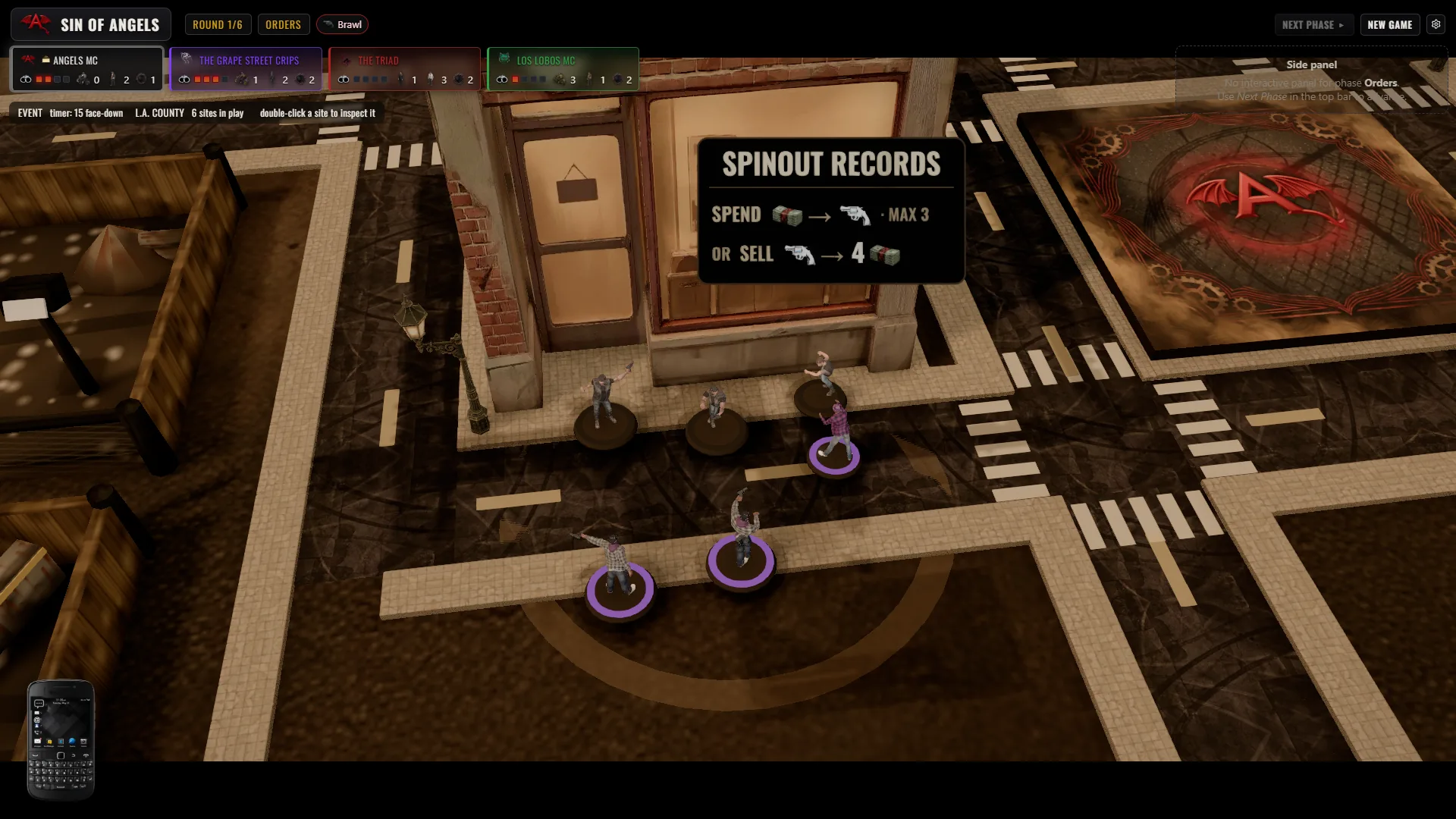
When clubs clash on a site, it triggers a Brawl. Instead of just showing a dice result, the game plays out a cinematic 3D battle. When a rider goes down, you see an atmospheric death vignette. The game features a full original outlaw-country soundtrack and punchy sound effects to sell the gritty Americana vibe.
Play Your Way
No install needed. We built Sin of Angels to solve the hardware problem. It's a website. You don't install anything. It runs on desktop, tablet, and phone.
There is no native iOS app because iPhone users just play directly in the browser. A native Android app is on the way, and a Steam release is coming for PC players.
You can play a full session in about six rounds. It works for a dedicated game night or a quick match. You have four ways to play:
- Online Multiplayer: Play remotely with friends across different devices.
- Solo vs AI: Test your strategy against a smart single-player opponent.
- Pass-and-Play: Hand a single device back and forth in the same room.
- Party Mode: Throw the 3D board up on a TV. Everyone in the room plays from their own phone.
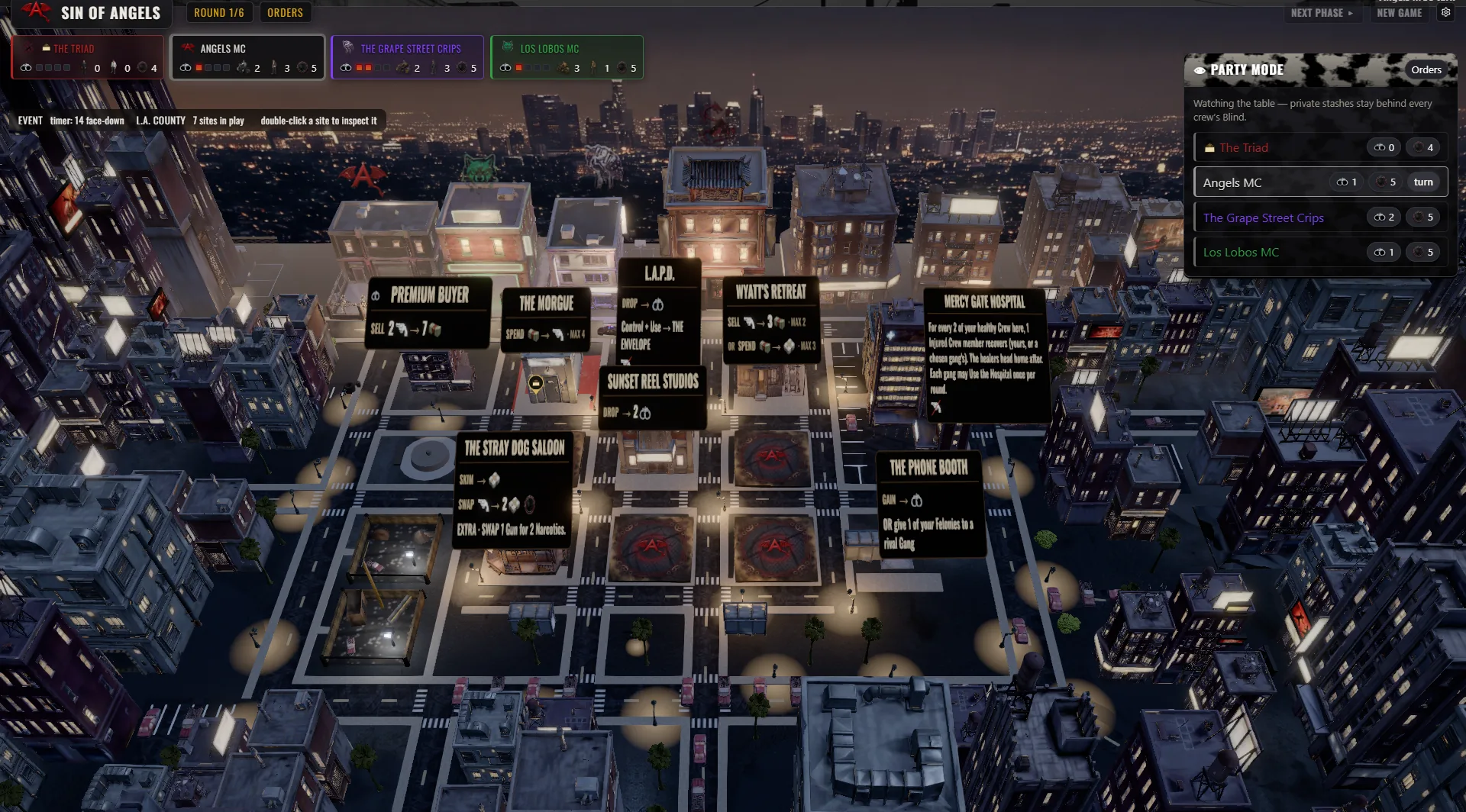
It's a fast, brutal game of area control and negotiation. You run The Silk Road, manage your Felonies with the law, spend orders each turn, and fight for the Envelope.
Join the Beta
Sin of Angels is in closed beta at soa-game.com. Get on the list and you play early, and the bugs you report shape what ships.
Related Guides
- Sin of Angels: The Outlaw Motorcycle Club Strategy Board Game
- Is Board Game Arena Free? What You Get, and the Alternatives
- Board Game Arena Alternatives Worth Trying
- The Best Board Games on Steam (and Where to Play Free)
Frequently Asked Questions
What counts as an online tabletop game?
An online tabletop game is any digital adaptation of a board game, card game, or roleplaying game. It can be a 3D physics sandbox where you move virtual pieces manually. It can also be a fully programmed digital board game with automated rules and custom graphics.
Are online tabletop games free to play?
Many platforms offer free tiers where you can play classic titles at no cost. Premium games usually require a purchase or a subscription. Often, only the person hosting the game needs to pay, allowing friends to join their lobby for free.
Can you play online tabletop games with friends on different devices?
Yes, many games support cross-platform play. Browser-based games are the most accessible, allowing players on PCs, Macs, tablets, and phones to join the same lobby. Always check a game's cross-play capabilities before buying.
What's the difference between an online tabletop game and a video game?
Online tabletop games adapt the mechanics of physical board games, relying on turn-based strategy, dice rolls, and card draws. Traditional video games often focus on real-time action or physics. Digital board games preserve the social negotiation and structured turns of a physical game night.
Do online tabletop games work on mobile?
Many do, either through native apps or mobile web browsers. Screen size can be a limiting factor for complex strategy games with large boards. Games built specifically with mobile UI in mind offer the best experience on a phone.
Can you play online tabletop games solo against AI?
Dedicated digital board games often include a solo mode with AI opponents. This allows you to learn the rules or test strategies without needing a group. Sandbox platforms usually lack AI, requiring you to play against real people or control multiple factions yourself.
Claim Your Turf
Moving your game night online doesn't mean settling for a lesser experience. Want a heavy strategy game with friends across the country? Or a solo run against AI? Either way, the right digital board game makes it happen. Sin of Angels brings the grit of an outlaw motorcycle club straight to your browser or your living room TV.
Claim Your Spot in the Beta and get ready to run the streets.