
What Is a Virtual Tabletop? Playing Board Games Online, Explained

A virtual tabletop is a digital platform for playing board games and roleplaying games online with a remote crew. It replaces the physical table with a shared screen: digital maps, tokens, dice, and turn trackers, with everyone logged in to look at the same board.
Key Takeaways
- A virtual tabletop syncs a shared digital board across every player's device in real time.
- The market splits into three categories: 3D sandboxes, automated rules engines, and ready-made games.
- Sandboxes give total freedom but enforce zero rules; automated engines and ready-made games handle the math.
- Browser platforms have the lowest barrier to entry; Steam needs horsepower, mobile trades screen space for convenience.
- Sin of Angels is a ready-made game: automated rules, cinematic 3D Brawls, and a browser-based TV party mode.
Why Move Online?
Getting your group together in one room is a logistical nightmare. People move away. Work schedules clash. Real life constantly gets in the way.
Taking your game night online bridges that gap. You do not need a massive dining room table. You just need a connection.
When you decide to move your crew to the digital space, you are not just picking a game. You are picking an ecosystem. You are choosing between:
- Heavy 3D sandboxes that require you to enforce your own rules
- Automated engines that handle the math for you
- Ready-made games built from the ground up for one specific experience
You also have to decide how your group will connect. Some virtual tabletop software requires a heavy download on Steam. Others run right in your browser or on a mobile device.
Below, we break down exactly how these platforms operate. You need to know what you are getting into before you try to get your crew to the table.
How Does a Virtual Tabletop Work?
A virtual tabletop works by syncing data across every player's device in real time. When you move a token or flip a card on your screen, a data packet travels to a host server. That server updates everyone else's view instantly, so the whole crew sees a shared board.

The technology has evolved. We are no longer trading moves through clunky email chains or basic text forums. Modern platforms run on dedicated servers that handle thousands of simultaneous connections.
Stability is everything. If the host server drops a connection mid-turn, the tension dies. The best systems run quietly in the background. You do not notice the netcode. You only notice the game.
The best virtual tabletop systems handle a lot of heavy lifting behind the scenes. They manage the physical space of the game:
- High-resolution maps and boards
- Snap-to-grid functionality so pieces line up perfectly
- Digital representations of plastic miniatures, wooden meeples, and cardboard tokens
Hidden information matters too. In a physical game, you hold your cards close to your chest. An online tabletop game replicates this with private digital hands. You can see your cards, but your rivals only see the back of the deck.
The software handles the fog of war behind the scenes. It blocks line of sight. It keeps your secrets safe until you are ready to play your hand.
Then there is the randomizer. Physical dice are chaotic. Digital dice either use a physics engine to simulate a real roll, or they use an algorithmic random number generator to spit out a result. Both methods ensure the game remains unpredictable.
Communication ties it all together. Some platforms build voice and text chat directly into the interface. Others assume you are already running a separate voice call with your crew. Either way, you need to talk trash, cut deals, and coordinate your moves.
The Options Sorted by Category
Not all virtual tabletop games operate the same way. The market splits into three distinct categories, and each one offers a completely different experience. You have to match the platform to your crew's playstyle.

The 3D Sandbox: Total Freedom and Total Chaos
A 3D sandbox is exactly what it sounds like: a physics simulator. When you load into the game, you see a three-dimensional room, a table, and boxes of components. You have digital hands.

Click, drag, drop. If you want to play a card, you click it, drag it, and drop it on the table. If you want to roll a die, you pick it up and throw it.
These platforms offer total freedom. Because they are just physics engines, they do not care what game you are playing. You can load up a virtual tabletop RPG map, drop in some fantasy miniatures, and start a campaign.
You can just as easily load up a complex strategy board game and arrange the pieces yourself.
If someone in the community has built a digital modification for a game, you can play it here:
- You can point at things
- You can knock pieces over
- You can literally flip the digital table if you lose a bad fight
These platforms operate like the wild west. They rely entirely on community labor. If you want to play a niche strategy game, you have to hope someone else took the time to scan the cards, model the pieces, and upload the files.
You spend a lot of time hunting for the right assets. When it works, it is brilliant. When an asset link breaks and half your deck loads as blank white squares, it ruins the night. You are trading stability for absolute freedom.
But that freedom comes with a massive catch. The software does not know the rules:
- It will not stop you from making an illegal move
- If a player tries to move ten spaces when they only rolled a four, the game lets them
- You have to police your own crew and know the rulebook inside and out
Setup also takes time. You have to pull the pieces out of digital bags, shuffle the decks manually, and arrange the board before you can even start.
It feels the most like a real physical game night, complete with all the clunky setup and cleanup.
The Automated Rules Engine: Strict, Fast, and Flat
An automated rules engine enforces the rules with an iron fist, the opposite approach from a sandbox. When you log into one of these sites, you usually see a flat, two-dimensional board. The interface is clean and functional.
You cannot cheat on an automated engine, and you cannot make a mistake. When it is your turn, the game highlights your legal moves; click anywhere else and nothing happens. The engine also does the busywork:
- It tracks your resources
- It calculates the combat modifiers
- It scores the match the moment it ends
There is no arguing over the rulebook. The engine is the judge, jury, and executioner.
Find ranked matchmaking. Because the engine handles the math, these platforms breed highly competitive environments. You will find ranked matchmaking, ELO scores, and global leaderboards. You can jump into a lobby with strangers and test your skills against absolute sharks who know every optimal move.
It strips away the social negotiation of a physical table and replaces it with pure, ruthless efficiency. You play to win, and you play fast.
This makes the gameplay incredibly fast. You can burn through a complex strategy game in half the time it would take in real life. These platforms host thousands of different games and run efficiently.
The tradeoff is atmosphere. You lose the tactile satisfaction of slamming a piece down on the board. You click a button, and a number changes. It can feel a bit like operating a spreadsheet, functional but missing the grit of a real physical Brawl.
The Ready-Made Game: Built for Immersion
A ready-made digital board game is a standalone experience built from the ground up for one specific rule set, not a giant platform hosting a thousand different games. Sometimes you do not want a massive hub of games. You just want one game built perfectly.
Production value comes first here:
- Original art direction and soundtracks that set the mood
- Real animations, so a fight over a piece of territory plays out as more than a number change on the screen
You might see a cinematic battle play out instead. The rules are fully automated, just like the 2D engines, but the presentation is top-tier.
Mood-setting is the real selling point. A dedicated digital board game controls the entire environment and dictates the mood. When you muscle a rival crew off a piece of turf, you hear the punchy sound effects and the dark Americana soundtrack swelling in the background.
It feels less like a tabletop simulation and more like stepping into a gritty crime drama. The developers control the pacing. They build in death vignettes and atmospheric cutscenes that a generic platform could never support.
A standalone game also gives you options that generic platforms cannot match:
- Because the developers know exactly how the game works, they can build a smart AI opponent.
- You can play a solo match when your crew is offline and still get a curated experience.
This is exactly the lane Sin of Angels lives in. It is in closed beta now: get on the list, and you play early while your bug reports help shape what ships. Get Early Access
The only downside is flexibility. You are locked into that single game. If you want to play something else, you have to launch a completely different application.
The Three Categories at a Glance
| Category | Rule Enforcement | Setup | Best For | Downside |
|---|---|---|---|---|
| 3D Sandbox | None, you police your own crew | Manual, pull pieces from digital bags and arrange the board | Groups who want total freedom and a physical game night feel | No stability guarantee, broken community assets, no illegal-move protection |
| Automated Rules Engine | Full, the engine handles all the math | None, the game highlights your legal moves | Fast, competitive play with ranked matchmaking and leaderboards | Can feel sterile, like operating a spreadsheet |
| Ready-Made Game | Full, rules are fully automated | None, built for one specific rule set | Immersive, cinematic presentation with a solo AI option | Locked into a single game |

Where the Game Lives: Browser, Steam, and Mobile
Weighs browser, Steam, and mobile access by horsepower, screen size, and battery life.
Where your game lives, in a browser, on Steam, or on mobile, is the other half of the decision, and it dictates who can actually show up to game night. You have three main paths.

The Browser Advantage: Drop In and Play
Running a game directly in a web browser offers the lowest barrier to entry. No one has to download a massive file or install a dedicated client. You spin up a lobby, send a link to your crew, and they are in.
Browser-based games work almost anywhere:
- On a desktop rig
- On a cheap laptop
- On a tablet
- On a phone, if the interface is built for it
This eliminates the friction of getting a group together. You do not have to wait for a friend to update their software before you can start the match.
For a lot of groups, a browser setup is the only way to guarantee everyone actually makes it to the table.
True cross-device play changes how a crew games. You can start a match on your desktop at home, take your next turn on your phone while waiting for a coffee, and finish on a tablet on the couch. It bleeds into your daily routine.
You do not have to block out a rigid four-hour window on a Friday night. You just keep the tab open and make your move when the time is right.
Steam and Downloaded Software: The Heavy Duty Route
The heavy hitters usually live on Steam or require a dedicated software download. This is where you find the massive 3D physics sandboxes and the highly complex virtual tabletop software used for deep roleplaying campaigns.
Need processing power. These applications require a real computer. You cannot run them smoothly on a ten-year-old laptop. They demand processing power and a decent graphics card.
The visual fidelity is higher and the physics engines are smoother, but the barrier to entry is steep.
Every person in your crew needs to create an account, download gigabytes of data, and own a machine that can handle the load. If one guy in your crew only has a tablet, he is sitting this one out.
You also have to deal with the troubleshooting nightmare of PC gaming:
- Someone has an out-of-date client
- Someone has a driver issue
- Someone forgot their password and has to reset their entire account
You spend the first forty-five minutes of game night just trying to get all six players into the same digital lobby. When it fires on all cylinders, the experience is unmatched. But getting the engine to turn over takes work.
The Virtual Tabletop App: Taking It Mobile
The final option is the mobile route: you download a virtual tabletop app from an app store. These are built specifically for touch controls, great for a quick game on the couch or taking your turn while riding the train.
But screen real estate is a serious problem. Strategy board games take up a lot of physical space.
Cramming a massive map, a hand of cards, a pile of tokens, and a turn tracker onto a six-inch phone screen can be miserable. You spend half your time zooming in and out just to see what is happening.
Battery life takes a hit too. Running a complex game natively on a phone drains the battery fast. Your device heats up, and the notifications get in the way. A dedicated app is a great secondary tool, but it struggles to serve as the main event.
The smart developers bypass this by using the phone as a controller rather than the main board. You throw the game up on the TV, everyone connects via their mobile browser, and you keep your private cards in the palm of your hand. That is how you run a modern game night.
The Cost of the Table: Free vs Paid Platforms
Breaks down free-tier limits, one-time fees, add-on costs, and hardware requirements.
The barrier to entry usually comes down to cash. When you look for a virtual tabletop free of charge, you are usually looking at a basic tier. You can check out our guide on is board game arena free to see exactly how these subscription models limit your access.
- Free tiers are limited. They let you sit at the table, but they lock the premium games behind a paywall. If you want to host the heavy hitters, someone in your crew has to buy a subscription.
- Other platforms work differently. They skip the subscription and hit you with a one-time fee instead. You buy the software on a digital storefront and own it forever. You can read our guide on board games on steam to see how the PC ecosystem handles these purchases.
- Add-ons add up. You still have to buy the digital versions of the individual board games as extra content, and it adds up fast. If your crew wants different ways to play without burning cash, explore our guide on board game arena alternative platforms to see what else is out there.
- Hardware costs too. A heavy 3D engine will not run on a cheap tablet. It will cook the battery and crash the device.
If your crew is split across PCs, Macs, and phones, you need a platform that supports them all, matched to the weakest device in your group. If one player cannot load the board, the whole night falls apart.
How to Choose: The Three-Question Test
Distills the choice into three questions: who enforces rules, where you play, and cost.
Every platform above breaks down along the same three lines, so you can skip the guesswork with three questions instead of reading another ten-platform roundup.

- Who enforces the rules? A 3D sandbox leaves it to your crew; an automated engine or a ready-made game handles it for you.
- Where does your group actually play? Browser means zero friction, Steam means more horsepower and more setup, mobile means convenience with a smaller screen.
- What does it really cost? Factor in the subscription or one-time fee, the per-game add-ons, and the hardware every player in your crew already owns.

Answer those three, and you have effectively picked your category, your access method, and your budget in one pass.
Where Sin of Angels Fits
Pitches Sin of Angels: outlaw MC theme, cinematic Brawls, browser party mode.
Run the Three-Question Test above on Sin of Angels and it never touches a sandbox or a generic engine; it is our outlaw-MC strategy board game built from the ground up for one specific experience. You run your own outlaw motorcycle club in a gritty California underworld.
Build your crew. You build your crew, muscle rival gangs off the streets, run guns, and bleed the town dry. You cut deals with other players at the table, and then you break them when the time is right.
Because it is a ready-made game, you do not have to enforce the rules. The engine handles the math, the hidden information, and the combat modifiers.
When clubs clash on a piece of turf, it triggers a cinematic 3D Brawl, so you watch your rivals take a beating instead of just watching a number tick down.
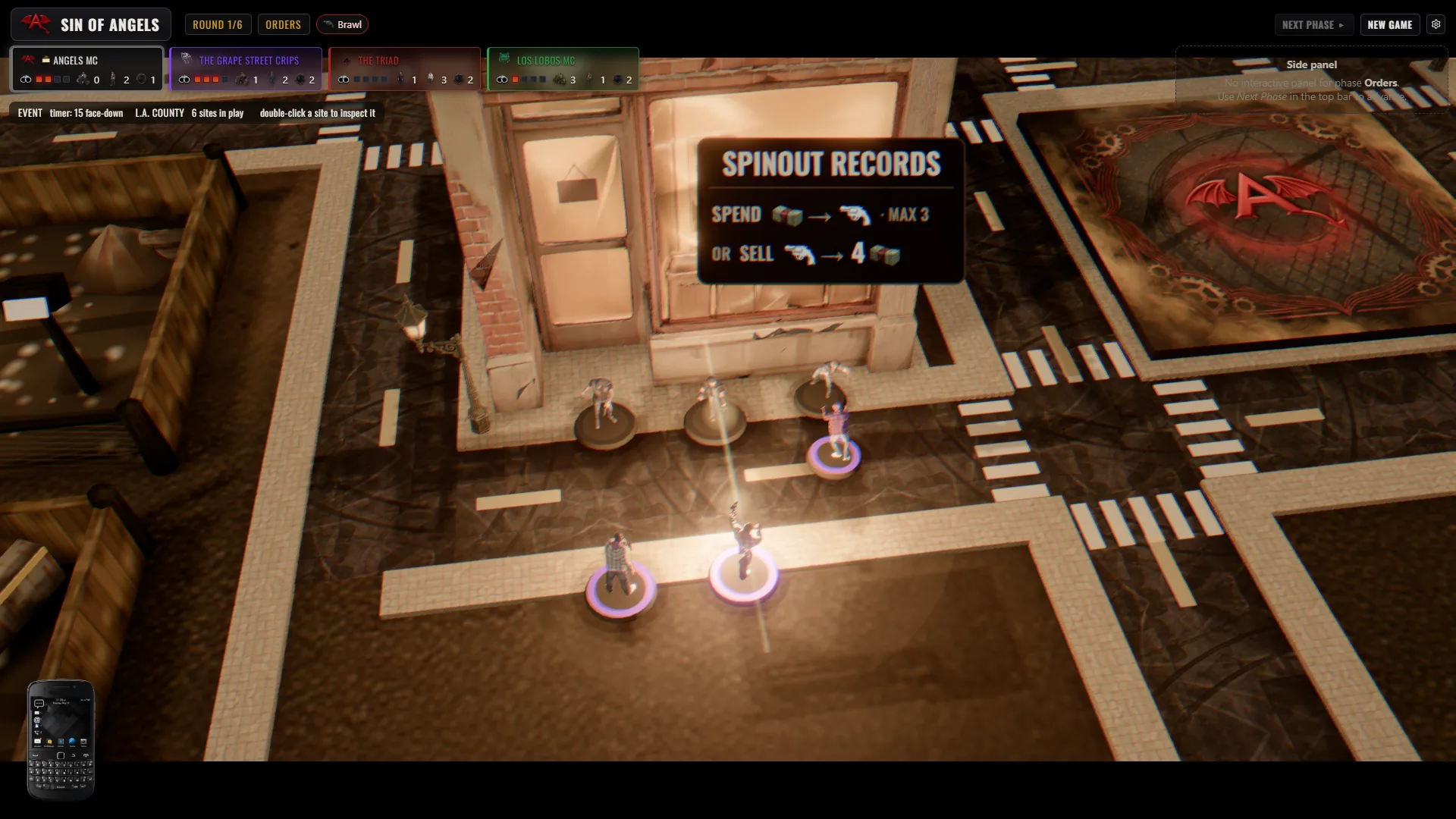
No heavy install required. We built it to eliminate the friction of getting your crew together. It runs directly in your web browser.
You can play on a desktop, a tablet, or a phone. iPhone users play right in the browser. A native Android app and a PC release via Steam are planned for the future.
Party mode is the sweet spot. You can play online with friends across the country, or run a solo match against a smart AI opponent.
But the best way to run it is party mode: throw the 3D board up on the TV, and everyone in the room connects and plays from their own phone.
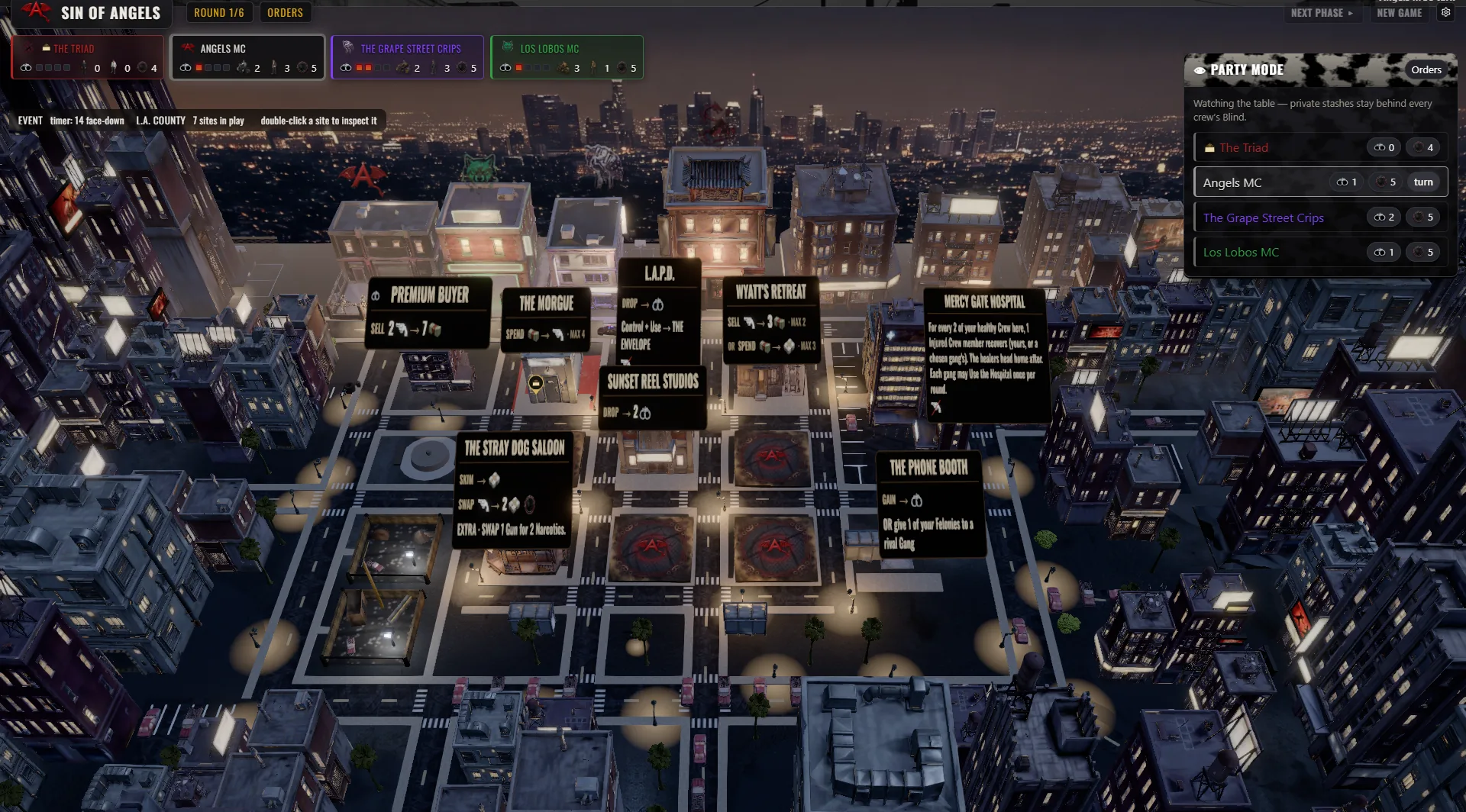
You keep your private cards hidden in your hand while the main action plays out on the big screen. Nobody has to learn a complicated interface or download gigabytes of data. You just drop in, grab your cards, and start making moves.
Join the Beta
Sin of Angels is in closed beta at soa-game.com. The beta list is open, and early players get in first and help us break it before launch.
Related Guides
- Sin of Angels: The Outlaw Motorcycle Club Strategy Board Game
- Is Board Game Arena Free? What You Get, and the Alternatives
- Board Game Arena Alternatives Worth Trying
- The Best Board Games on Steam (and Where to Play Free)
Frequently Asked Questions
What are the best free virtual tabletops?
Many platforms offer a free basic tier. These free accounts let you join games hosted by paying members or play a limited selection of classic titles. If you want to host premium games, you usually need a paid subscription.
What are the different types of virtual tabletops?
The market is split into three main categories. You have 3D physics sandboxes that give you total freedom but enforce no rules. You have automated 2D engines that handle all the math for you. Finally, you have ready-made digital board games built specifically for one set of rules.
How does a virtual tabletop work?
A virtual tabletop software syncs a digital board across multiple remote devices. It manages the physical space with digital maps, tokens, and dice. When you make a move on your screen, a host server instantly updates the view for everyone else in your crew.
Can you use a virtual tabletop for a strategy board game, not just RPGs?
Yes. While many platforms focus on roleplaying campaigns, others are built entirely for strategy board games. You can find digital adaptations of area-control games, worker placement games, and card games.
Do you need to download anything to use a virtual tabletop?
It depends on the platform. Heavy 3D simulators usually require a software download on a PC or Mac. Browser-based platforms require no installation at all, letting you drop in and play directly from a web link on any device.
Gather Your Crew
Taking your game night online keeps your crew connected when real life gets in the way.
Whether you want to battle the AI, run a match online with friends, or put the board on the living room TV, you can Get on the Beta List and claim your turf early.