
Engine-Building Board Games: How the Mechanic Works + Best Picks

An engine building board game is a tabletop strategy game where players start with limited resources. You gradually build a system of cards, tiles, or abilities that generate more resources and points on future turns. You invest your early actions to create a machine that runs itself late in the game. It is the snowball effect in cardboard form.
The pattern plays out the same way almost every time:
- You start with a terrible hand and zero resources.
- You buy a card that gives you one coin per turn.
- A few turns later, that coin buys a card that gives you three.
- By the final round, your setup churns out massive combos and victory points while your opponents watch you run the table.
Key Takeaways
- An engine builder rewards players who invest early rather than chase points from turn one.
- Splendor, Terraforming Mars, Race for the Galaxy, and Wingspan are the genre's benchmark titles.
- Every engine builder runs on three phases: Build-Up, the Pivot, and Cash-Out.
- Catan has loose engine elements but relies on dice, so hobbyists rarely call it a true engine builder.
- Sin of Angels swaps card engines for a turf-fueled economy, with the Brawl as its pivot moment.
The player who understands how to build a machine out of scraps is the one who walks away with the win.
This mechanic dominates the tabletop scene because it feels incredibly rewarding. You are not relying on lucky dice rolls or random chance. You are relying on a system you built from the ground up.
That holds whether you are playing a physical box on a table or a digital adaptation online. Building a flawless engine is the ultimate strategic high.
What Is an Engine Building Board Game?
An engine building board game is a genre where your early actions permanently upgrade your future ones. The goal is to construct a personal system, your "engine," that gets more efficient as the game goes on.
Board game engine building relies on a specific gameplay loop:
- Start with nothing: You begin with basic actions and meager resources. You are fighting for scraps.
- Invest in infrastructure: You spend your early turns buying cards, claiming tiles, or unlocking abilities rather than scoring points.
- Create synergies: You combine pieces that feed into each other. A card that produces wood feeds a card that turns wood into gold.
- Run the machine: You trigger your engine to generate massive payouts in the late game to secure the win.
Engines typically fall into a few distinct categories:
- Resource engines exist purely to generate wealth. You build them to flood your reserves with money, raw materials, or trade goods.
- Card-draw engines give you options.
Drawing more cards lets you cycle through the deck faster than your rivals to find the exact tools you need.
- Victory point engines act as your endgame. These machines convert your hoarded resources or cards directly into the points required to win the game.
The tension comes from timing. If you spend too long building your engine, the game ends before it pays off. If you start scoring points too early, a rival with a better machine will outpace you late. You have to know exactly when to stop building and start bleeding the board dry.
If that timing problem is the part you like, Sin of Angels runs the same build-then-cash-out squeeze on a map of turf. It is in closed beta now, and the beta list is how you get in. Join the Beta
The Core Tension: Building vs. Scoring
Breaks engine building into Build-Up, Pivot, and Cash-Out phases with a turn-by-turn iron-to-factory example and a solo-vs-competitive comparison.

The best engine building board game designs force you to make hard choices every single turn. You are always balancing the future against the present. That rhythm breaks down into three phases: Build-Up, Pivot, and Cash-Out. It is the timing lens serious players use to read any engine builder, including every game on this page.
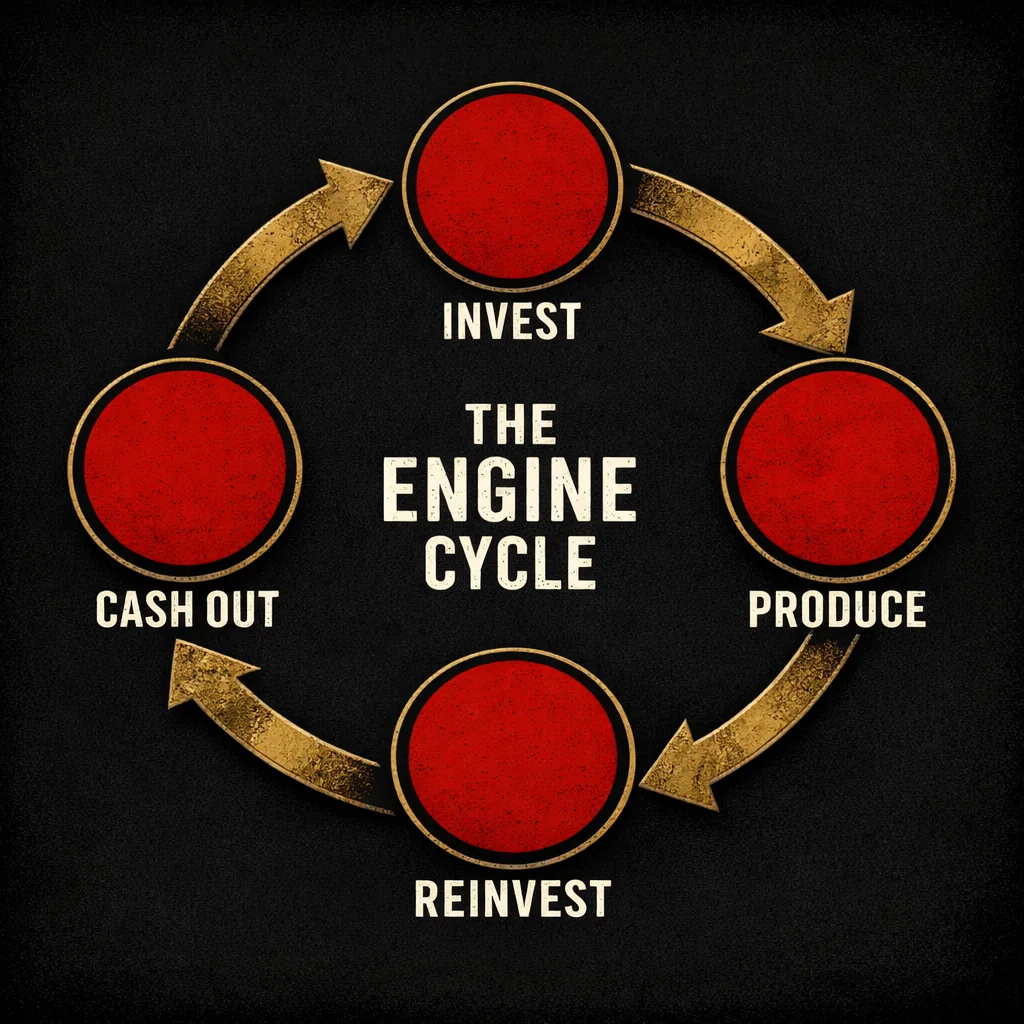
The Build-Up phase is a grind. Early on, everyone is poor. You take a whole turn just to scrape together enough currency for one low-level asset.
It feels slow, but that slow start is deliberate; it makes the late-game explosion feel earned. Every decision feels heavy here. Resources are scarce, and one bad purchase can stall your momentum for the rest of the night.
The Pivot is the most dangerous turn of the game. Every engine builder has a tipping point. You have to look at the board, look at your opponents, and decide when to flip the switch.
If you buy another resource generator in the final round, it is completely useless; it will never pay for itself. You need to transition from building capacity to cashing in for victory points.
The Cash-Out phase is the victory lap. If you built your engine right, this phase runs on autopilot. You trigger your abilities, collect your points, and watch the math work in your favor.
Creating the Snowball Effect
Engine building board game design relies on compounding interest. You are not just getting stronger. You are getting exponentially faster.
Imagine a simple setup:
- Turn one: you gain one iron.
- Turn two: you use that iron to buy a foundry.
- Turn three: the foundry produces two iron.
- Turn four: you use the two iron to buy a factory that produces victory points.
You built a pipeline. That is why players get hooked. The satisfaction loop is undeniable. When your machine fires perfectly, it feels like you broke the game. Chaining three or four abilities together in a single massive turn will do that. You outsmarted the system, and you did it entirely through your own strategic choices.
Solo and Competitive Dynamics
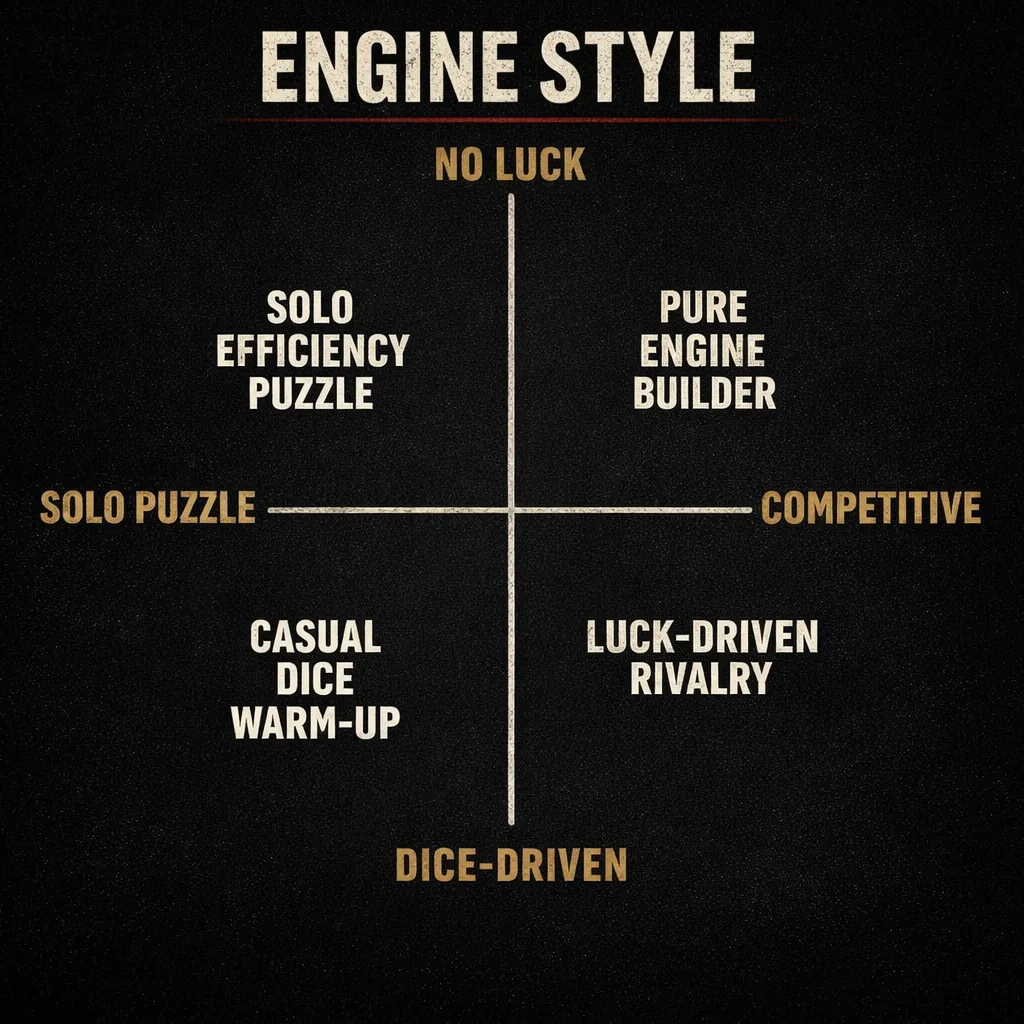
Many players look for solo engine building board games because the mechanic works beautifully as a solitary puzzle.
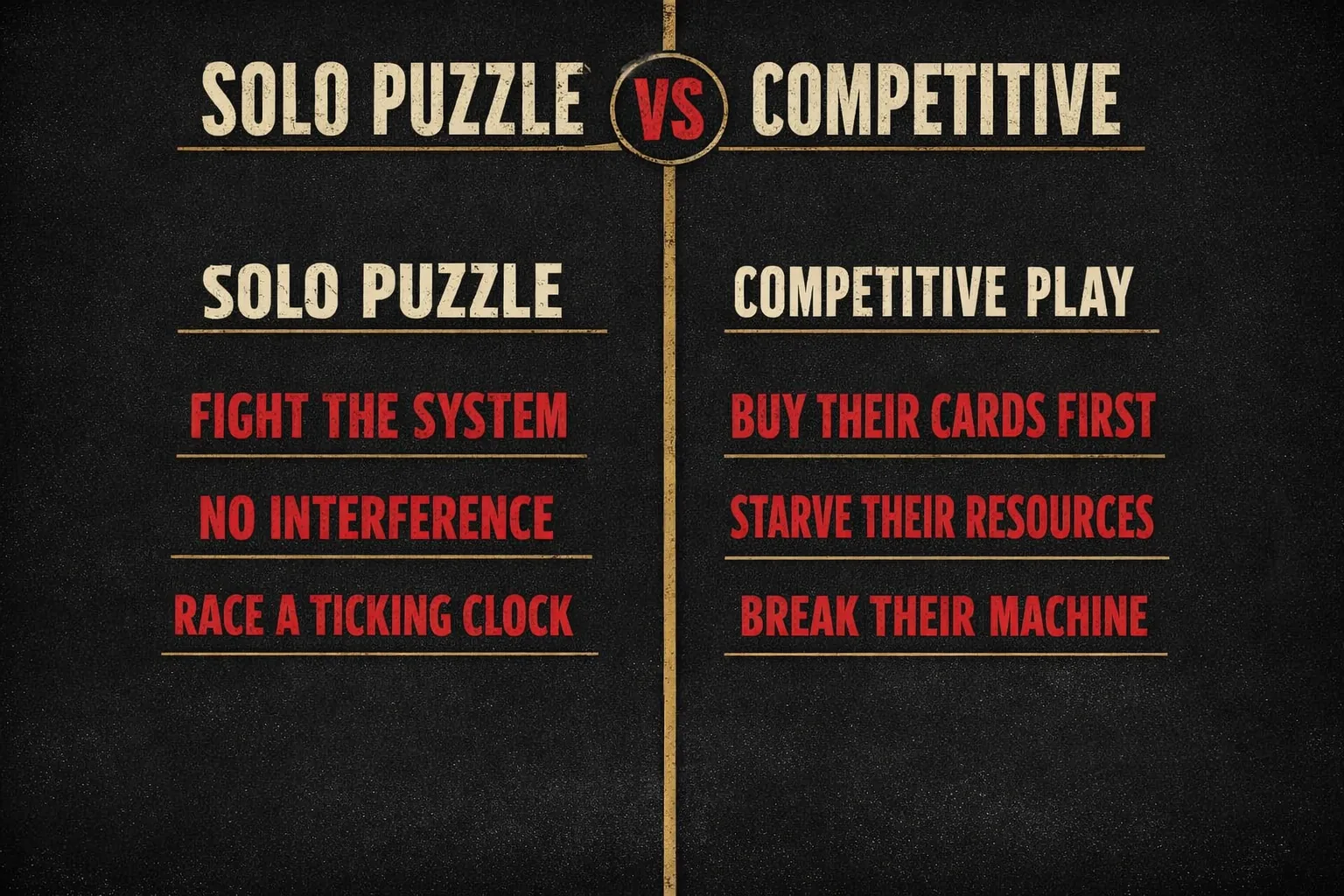
You are fighting the system itself. You are testing your ability to optimize a puzzle without interference, against a ticking clock or a high score. The best solo engine building board games strip away the noise and let you focus entirely on pure efficiency.
In competitive play, the dynamic shifts. It becomes a street fight. You are not just building your own machine, you are watching your rivals build theirs. If you see an opponent assembling a massive resource engine, you have three moves:
- Buy the cards they need before they can.
- Starve them of the resources they require.
- Break their machine before they can turn it on.
The best engine building board games 2026 has to offer blend this internal puzzle with sharp, cutthroat player interaction.
Examples of Engine Building Board Games
If you want to understand how the mechanic works in practice, you have to look at the heavy hitters. These titles define the genre.

They show how flexible the concept can be, ranging from quick card games to massive tabletop campaigns.
Here are some of the most prominent examples of engine building board games on the market.
At a Glance: The Games Covered Here
| Game | Engine Type | Feel | Best For | Players | Play Time | Complexity (/5) |
|---|---|---|---|---|---|---|
| Splendor | Pure economic engine: buy cheap cards to afford expensive ones | Fast, ruthless, entirely focused on efficiency | Beginners wanting a fast, pure experience | 2-4 | 30 min | 1.77 |
| Terraforming Mars | Sprawling resource-production engine | Massive, complex, deeply rewarding | Players who want a heavy tabletop campaign | 1-5 | 120 min | 3.27 |
| Race for the Galaxy | Card-driven, multi-use card engine built on phase synergies | Tight, aggressive, fast-paced | Players who want ruthless efficiency and no room to hesitate | 2-4 | 30-60 min | 2.99 |
| Wingspan | Activation-chain engine: birds trigger abilities down the line | Accessible, relaxing theme with cutthroat math underneath | Players who want an approachable but tight engine builder | 1-5 | 40-70 min | 2.48 |
| Catan | Loose, dice-dependent resource engine | Light engine elements, luck-driven | Players who want a gateway game, not a true engine builder | 3-4 | 60-120 min | 2.28 |
| Sin of Angels | Turf-fueled resource engine: Sites generate Cash, Guns, and Narcotics to fund your next move | Area-control economy building toward one violent Cash-Out | Players who want the Build-Up-to-Cash-Out arc fought over a map instead of a card row | 2-6 | one game night | n/a (not BGG-rated) |
Splendor: The Pure Distillation
Splendor is often considered the perfect gateway into board game engine building. It strips away the complex rules and leaves only the core loop.
How it works:
- You collect gem tokens as a merchant.
- You spend those tokens on development cards.
- Those cards act as permanent gems for future purchases.
- You buy cheap cards so you can afford expensive ones, and the expensive cards pay victory points.
It is fast, ruthless, and entirely focused on efficiency. You are constantly watching your opponents to see which cards they are targeting.
The reservation game matters just as much. You are not just buying cards for yourself. You are reserving cards you know your opponent needs, holding them hostage to ruin their math. If you build your engine one turn too slow, someone else will claim the high-value card you needed to win.
If denying your opponent a resource they need is your favorite part of engine building, Sin of Angels puts that same instinct on a map instead of a card row. Get on the beta list and be one of the first to try it. Get Early Access.
Terraforming Mars: The Heavyweight
When players debate the best engine building board game, Terraforming Mars is always in the conversation. It is massive, complex, and deeply rewarding.
You play as a corporation trying to make Mars habitable. You start with basic production across six resource types:
- Money
- Steel
- Titanium
- Plants
- Energy
- Heat
Over generations, you play project cards that boost these production tracks. A card might cost you money now but raise your steel output for the rest of the game.
The engine you build in Terraforming Mars is sprawling. By the end of a session, you are generating handfuls of resources every turn. You use them to crash meteors into the planet, build cities, and plant forests.
The game board itself becomes a weapon. You place a city to block a rival's forest. You steal their heat production. You muscle them out of prime real estate while your corporate engine hums in the background. The arc from scraping by on turn one to reshaping a planet on turn ten is the ultimate power trip.
Race for the Galaxy: The Card-Driven Classic
Race for the Galaxy uses a multi-use card system to create a tight, aggressive engine builder.
Every card pulls double duty. It can be played as a world or technology, but cards are also the currency you use to pay for them.
To build a powerful empire, you have to discard other cards from your hand. This forces agonizing decisions; you have to sacrifice good cards to build great ones.
Your engine here runs on phase synergies. If you build an engine that produces goods, you also need infrastructure to consume those goods for victory points. It is a fast-paced race where building an efficient machine is the only way to survive. It demands ruthless efficiency. If you hesitate, the game ends.
Wingspan: The Modern Hit
Wingspan took the tabletop world by storm by wrapping a tight engine building mechanic in an accessible, relaxing theme. You are bird enthusiasts trying to attract birds to your wildlife preserves.
Three habitats drive the action. When you play a bird card into a habitat, it makes the core action of that habitat stronger:
- Forest birds gather more food.
- Grassland birds lay more eggs.
What makes Wingspan work is the activation chain. When you take an action in a habitat, you trigger the abilities of every bird you have played there.
It reads right to left, like an assembly line of abilities firing in sequence. It looks peaceful, but the underlying math is cutthroat. It is a masterclass in satisfying engine building board game design.
Is Catan Engine Building?
Yes, but only in a very loose sense. In Catan, you build settlements to generate resources like wood, brick, wheat, sheep, and ore. You use those resources to build more settlements and cities, which generate even more resources.
That is an engine, technically.
The dice are the catch. Most hobbyists do not classify Catan as a true engine builder. The resource generation in Catan relies heavily on the luck of the dice. If the number eight does not roll, your city on the eight tile produces nothing.
True engine building board games remove that level of variance. In a pure engine builder, your machine runs because you built it correctly. It does not run because the dice happened to favor you.
Adjacent Mechanics and Genre Blends
Explains how deck building, worker placement, and area control mechanics relate to and often layer onto engine building.
Engine building rarely rides alone. The best tabletop strategy games bolt this mechanic onto other systems to create a heavier, more aggressive experience.
Deck building is the closest cousin. You start with a weak deck of cards and buy better ones to cycle through. Every hand you draw is a mini engine firing off. You trash your weak starting cards to ensure your heavy hitters show up exactly when you need them.
Worker placement is another natural fit. You drop your crew on the board to claim resources, then use those resources to upgrade your personal player board.
The engine you build dictates where you need to send your workers next. You are constantly fighting your opponents for the best spots on the board.
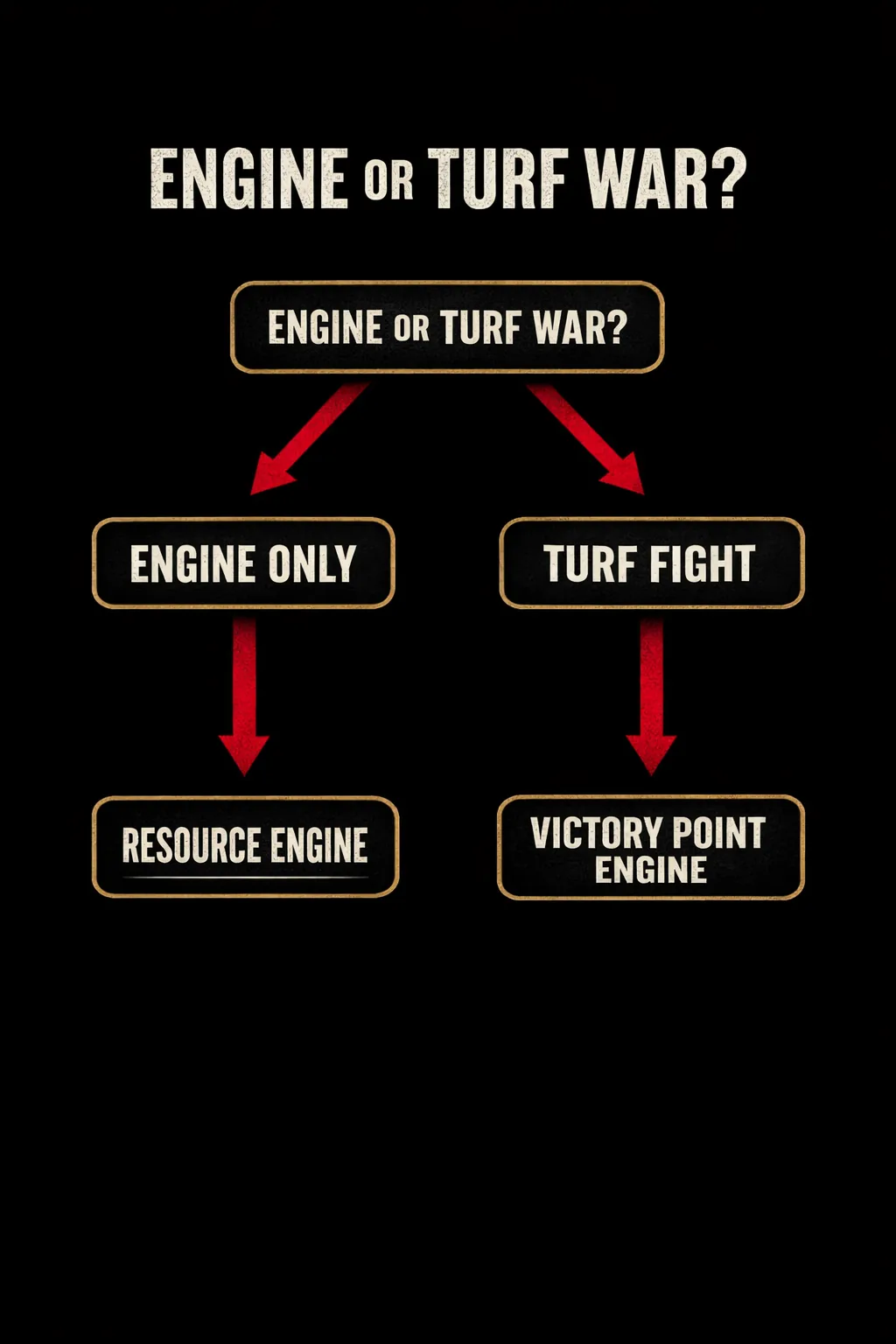
Area control brings the fight directly to the map. This is where the genre gets bloody. You are not just building a machine in isolation, you are fighting for the turf required to fuel it. If you want to see how that tension works, check out our guide on area control board games.
You push your crew onto the board, claim territory, and use the resources from that turf to fund your war chest. If someone wants to break your engine, they do not just buy a card. They muscle you off your land.
You can find similar escalation in our guide on 4x games or explore the cat-and-mouse tension detailed in our guide on hidden movement board game mechanics.
Sin of Angels: Engine Progression Meets Turf War
Pitches the site's own game, Sin of Angels — Members, Sites, and Brawls — with a closed-beta signup link.
The Pivot phase described above, deciding when to stop stockpiling and start converting, is the whole engine of Sin of Angels, except the switch you flip is a Brawl and the payout is Cash at the end of six rounds.
This is our outlaw-MC strategy board game. You run your own motorcycle club in a gritty L.A. County town.
Sin of Angels is a separate, independent game built from the ground up for digital play: 2-6 players, no box, no license tie. The licensed physical tabletop game Sons of Anarchy: Men of Mayhem (Gale Force Nine, 2014) is a boxed game for 3-4 players running about 90 minutes.
Sin of Angels is an independent game, not affiliated with or endorsed by FX or the publishers of Sons of Anarchy.
Here is the loop:
- You start with a handful of Members and Recruits, then push your crew onto the town's Sites to claim territory.
- A dive bar gets you cash, an arms dealer stocks your crew.
- You use those resources to recruit more muscle, buy narcotics, and cut deals along The Silk Road.
The violence funds the machine. You are building an economic engine fueled by turf war. When rival clubs step on your ground, it triggers a Brawl, and you settle it in a cinematic 3D battle.
No install needed. You will not need a massive table to play. Sin of Angels runs right in your browser: desktop, tablet, or phone (including iPhone via the browser). An Android app is on the way, and it's coming to Steam.
Play your way:
- Solo: run a campaign against a smart AI opponent.
- Online: jump in with friends across different devices.
- Party mode: throw the 3D board on the TV and everyone commands their crew from their own phones.
You build your club, bleed the town dry, and stack the most Cash by Round 6.
Join the Beta
Sin of Angels is in closed beta now at soa-game.com. Get on the list and you play early, and the bugs you report shape what ships.
Related Guides
- Sin of Angels: The Outlaw Motorcycle Club Strategy Board Game
- What Are 4X Games? Explore, Expand, Exploit, Exterminate Explained
- Area Control Board Games: How They Work and What to Play
- Hidden Movement Board Games: Cat-and-Mouse Strategy Explained
Frequently Asked Questions
What is engine building in board games?
It is a strategy mechanic where your early actions permanently upgrade your future turns. You invest resources to buy cards or abilities that generate even more resources later. The goal is to build a self-sustaining system that produces massive points by the end of the game.
What is the best engine building game?
Terraforming Mars and Wingspan consistently rank at the top for modern players. Splendor is the best choice for beginners wanting a fast and pure experience. The right choice depends on whether you want a quick card game or a heavy tabletop campaign.
What game lets you build engines?
Titles like Race for the Galaxy, Splendor, and Terraforming Mars are built entirely around this mechanic. Many digital strategy games also use engine-style progression to let you upgrade your faction over time. You start with basic actions and construct a machine that wins the game. Sin of Angels runs a similar build-to-payoff arc on a turf map instead of a card row, turning Sites into Cash, Guns, and Narcotics production, though those Sites can be fought over and taken from you mid-game, unlike a card engine sitting safely in your tableau.
Is Catan engine building?
Catan has light engine elements because your settlements generate resources to build more settlements. However, most players do not consider it a true engine builder. The heavy reliance on dice rolls for resource generation removes the pure strategic control found in dedicated games of the genre.
What is the #1 board game in the world?
Rankings shift constantly, but heavy strategy titles with engine-building elements often claim the top spot on community lists. Games that combine deep strategy, minimal luck, and satisfying progression dominate the modern tabletop scene.
Claim Your Turf
Building a flawless machine and watching it run the board is the ultimate tabletop high. Maybe you want to test your skills solo against a brutal AI. Maybe you want to throw the game on the TV and battle your friends.
Either way, Sin of Angels brings that strategic progression to the gritty underworld. Claim your turf, upgrade your crew, and hold the most Cash when the round counter hits six. Get on the Beta List to get in on the ground floor.
Sin of Angels is an independent game and is not affiliated with, sponsored by, endorsed by, or associated with FX, 20th Television, The Walt Disney Company, or the publishers of Sons of Anarchy or Sons of Anarchy: Men of Mayhem. All trademarks are the property of their respective owners.