
What Are 4X Games? Explore, Expand, Exploit, Exterminate Explained

4X games are strategy games built on four core actions, right in the name: explore the unknown map, expand your territory, exploit the resources you claim, and exterminate the rivals in your way.
Key Takeaways
- The four pillars, explore, expand, exploit, exterminate, must all be present or a game is not a true 4X title.
- 4X games start every player small on a hidden map; grand strategy drops you into an existing, fully visible world.
- The genre spans space epics, historical campaigns, and tabletop board games, all running the same core loop.
- Area control, engine building, and hidden movement are adjacent mechanics that 4X games borrow from directly.
- Sin of Angels compresses all four pillars into about six rounds, no galaxy or century required.
You start with a blank map and a small crew. You push into the unknown, claim territory, then bleed those sites dry for resources. Then you wipe out the rival factions standing in your way.
It is a genre built on pure escalation. You go from surviving your first few turns to dominating the entire board.
Long campaign: These games demand patience and a ruthless mindset. You do not just win a quick firefight and call it a day. You build an economic engine, manage your borders, and crush the competition over a long campaign.
Whether you are playing on a digital screen or sitting around a kitchen table, the tension is always the same: you watch your long-term plans collide with an enemy who wants the exact same turf.
If you want to understand the 4x games meaning, look at the engine running under the hood. It explains why this genre hooks players for hundreds of hours. It is not just about combat. It is about building an unstoppable machine.
The Four Pillars of 4X Strategy Games
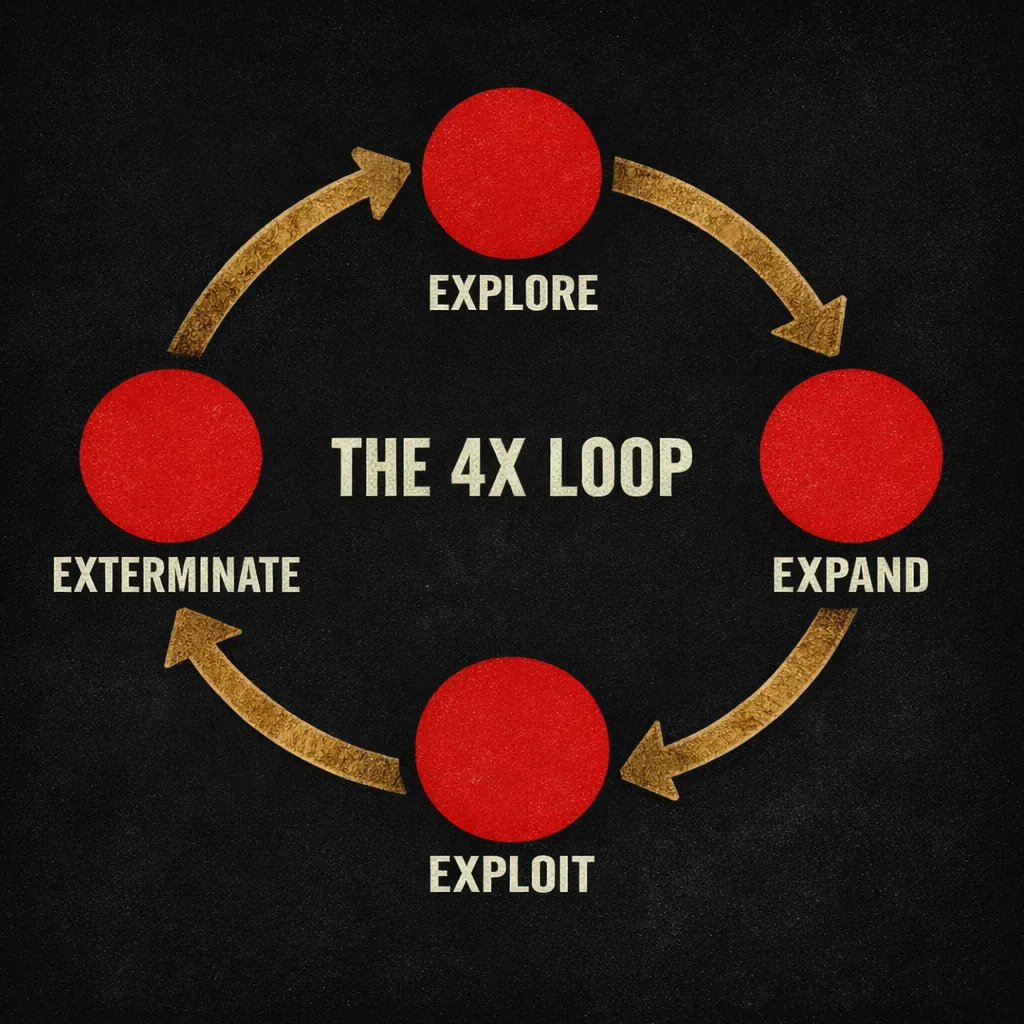
Every title in this genre leans on a specific four-part loop. If a game misses one of these pillars, it might be a great tactical experience, but it is not a true 4X game.

Explore
You never start with the full picture. The map is hidden behind a thick fog of war. You send out scouts to uncover the terrain tile by tile. You look for choke points, valuable resource nodes, and the borders of rival empires.
Information is your first weapon. If you do not know what is out there, you cannot plan your next move. Finding the right piece of land early can dictate your entire strategy. A good scouting run reveals where you can safely grow and where you need to build walls.
Expand
Expand means claiming the ground you just scouted. Once you know the lay of the land, you take it. You drop new settlements, outposts, or bases. Expanding your footprint gives you a wider net for resources, but it also stretches your defenses thin.
The more turf you claim, the harder it is to hold. You have to balance your greed for new territory with your ability to defend it. If you push out too fast, your supply lines break. Neighbors looking for an easy target will carve up your outer settlements.
Exploit
This is where you run the economy. You do not just sit on a piece of land. You build infrastructure to strip it of value. You mine raw materials, harvest food, and produce weapons.
You take those resources and turn them into power. A strong economy funds your war machine. You research new technologies and upgrade your facilities. If you fail to exploit your territory efficiently, your rivals will outpace you. They will show up at your borders with better gear and run you right off the board.
Exterminate
Exterminate is the final phase, when the board gets too crowded for anyone to stay friendly. The map fills up, borders rub together, and alliances fall apart.
You build an army and you take out the competition. You do not just win a minor skirmish. You eliminate the rival player from the game entirely. You burn their bases, take their resources, and claim their space as your own. In a true 4X experience, peace is only a temporary pause while you reload.
The Best 4X Games and Where They Shine
Covers 4X in space, historical, and board-game form, plus a Sin of Angels beta plug.
The best 4x games take these four mechanics and drop them into massive, immersive worlds. The setting changes, but the brutal logic of the genre stays exactly the same.
4X Space Games
Space is the perfect backdrop for this genre. You start on a single planet with basic technology. You research faster engines and colonize new star systems.
You manage entire galactic empires. You mine asteroids, negotiate with alien races, and build massive fleets to glass enemy planets. The scale is massive. The void of space makes the exploration phase incredibly tense. You never know what is waiting in the next star system.
Historical Turn-Based 4X Games
Historical titles let you take a culture from the stone age to the modern era. You build cities, research technology, and fight wars over centuries. Turn-based 4x games give you time to think.
You can calculate the exact cost of a war before you fire a single shot. The tension comes from watching a rival faction build a wonder or claim a resource you desperately need. You upgrade your armies from basic militia to modern armor, sweeping across continents.
4X Board Games
The genre is not just digital. Heavy 4x board games put the same massive conflicts right on your kitchen table. You sit across from your friends for hours. You push plastic miniatures across a hex grid.
You roll dice, trade resources, and betray each other in real time. Tabletop versions force you to look your rivals in the eye when you break a ceasefire. The politics of table talk and real-world negotiation make the exterminate phase incredibly personal.
Sin of Angels compresses all four pillars into a six-round game night. You claim a Site, work it for Cash, Guns, or Narcotics, and defend it before a rival club runs you off it. The beta list is open now: Get on the Beta List and play early.
Grand Strategy Games vs. 4X
Contrasts 4X's hidden-map start with grand strategy's pre-drawn world, plus a 4-question test to tell them apart.
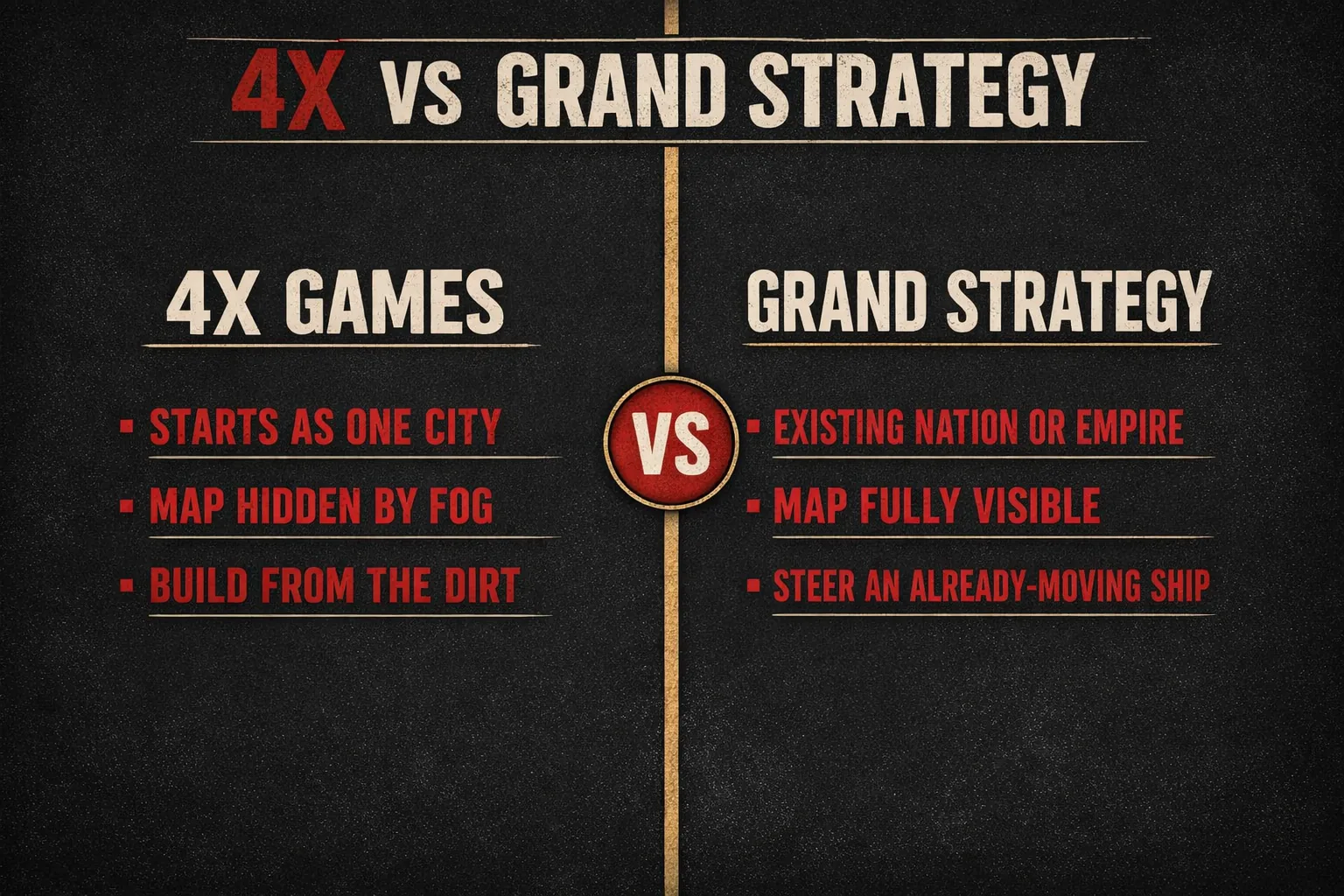
Players often confuse 4X strategy games with grand strategy games. They share a lot of DNA, but the starting line is entirely different.
In a 4X game, everyone starts small. You have one city, one planet, or one crew. The playing field is even. You build your empire from the dirt up. The map is a mystery, and your early choices shape your entire future. Every player has the exact same opportunity to explore and expand.
Already drawn: Grand strategy games drop you into a world that already exists. You might start as a massive empire in decline or a tiny nation trying to survive between two superpowers. The map is usually already drawn and fully visible from the first turn.
The focus is heavily on complex diplomacy, politics, and managing a massive state, rather than exploring a blank map. Both genres demand deep planning. 4X is about building the engine from scratch. Grand strategy is about steering a massive ship that is already moving.
| 4X Strategy Games | Grand Strategy Games | |
|---|---|---|
| Starting position | One city, planet, or crew | An existing empire or nation |
| The map | Hidden, revealed through exploration | Already drawn and fully visible |
| Early game focus | Explore and expand from scratch | Manage a state that already exists |
| Core tension | Building the engine from the dirt up | Steering a massive ship already in motion |
| Main emphasis | Territory, resources, expansion | Diplomacy, politics, managing scale |
The Four-Pillar Gut Check
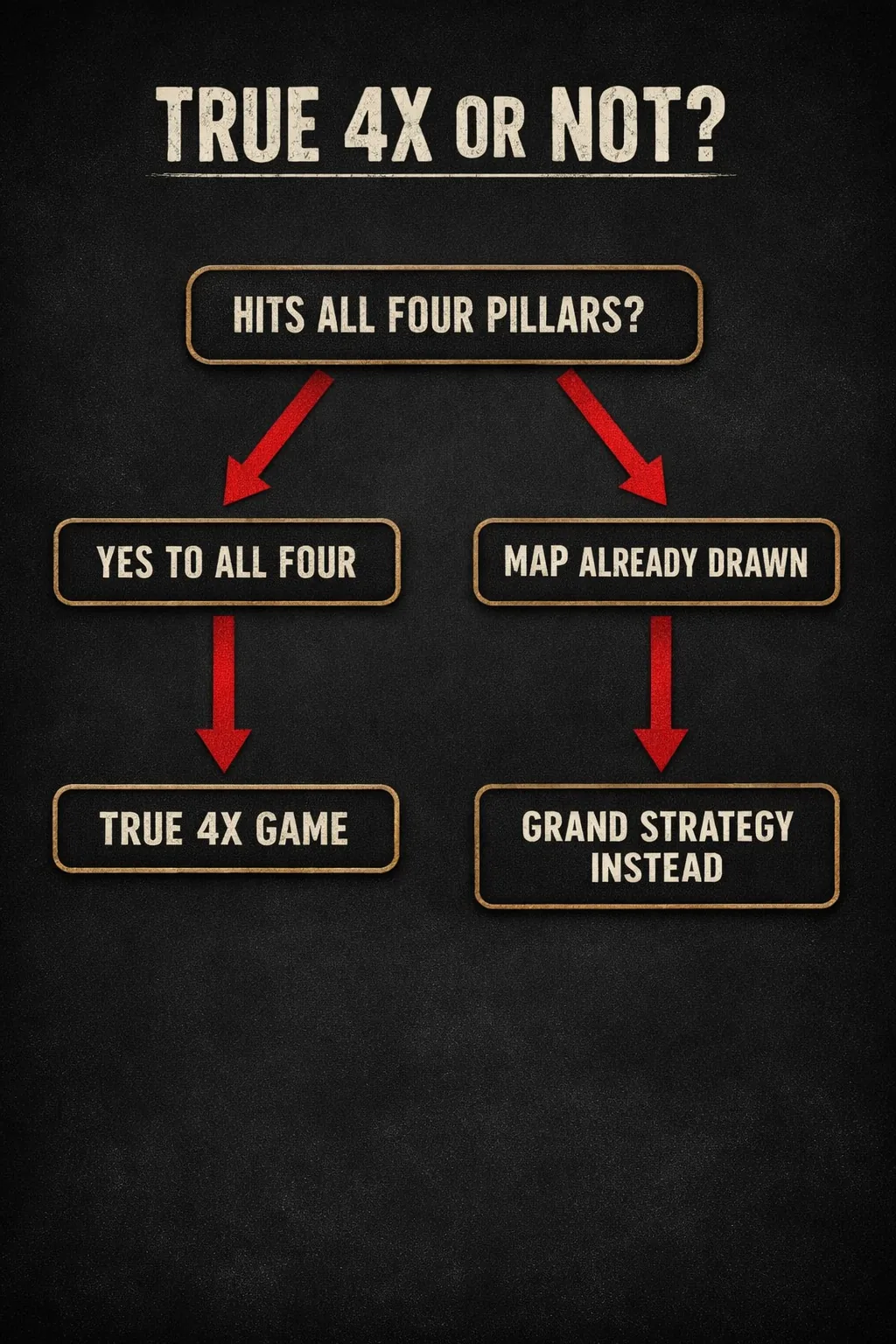
Not sure if a game you're eyeing is a true 4X title or something else wearing the label? Run it through this quick test using the pillars above:
- Does the map start hidden? If you have to scout it out through fog of war, that is the Explore pillar in action.
- Do you grow from one starting point? A single city, planet, or crew that grows into an empire is the Expand pillar.
- Do you build an economy on what you claim? Mining, farming, and researching to fund your growth is the Exploit pillar.
- Can you eliminate other players entirely? Full elimination, not just skirmishes, is the Exterminate pillar.
If a game answers yes to all four, it is 4X. If the map is already drawn and visible from turn one, per the table above, you are looking at grand strategy instead.
Adjacent Mechanics You Need to Know
Describes area control, engine building, and hidden movement as related mechanics, with links to deeper guides.
If you enjoy the ruthless expansion of a 4X title, you will recognize its mechanics elsewhere. They bleed into other tabletop and digital genres.
Area Control: Expanding and holding turf is the core of area control. You push your units onto the board, lock down vital sites, and fight off anyone who tries to take them. Games like Blood Rage and Rising Sun thrive on this mechanic.
You have to balance aggression with defense. If you want more on how this works, check out our guide on area control board games.
Engine Building: The exploit phase is pure engine building. You invest resources early to generate a bigger payout later. You build a factory to make more money so you can build a bigger factory. It is all about creating a self-sustaining loop of income. Learn more in our guide on engine building board game.
Hidden Movement: The explore phase relies on hidden information. Some games take this further by hiding the players themselves. You have to track down your rivals based on breadcrumbs and pure deduction. The fog of war becomes the entire game. Read our guide on hidden movement board game to see how it ramps up the tension.
Sin of Angels: Claim Your Turf
Pitches Sin of Angels, an outlaw-biker 4X board game, with gameplay details and a join-the-beta link.
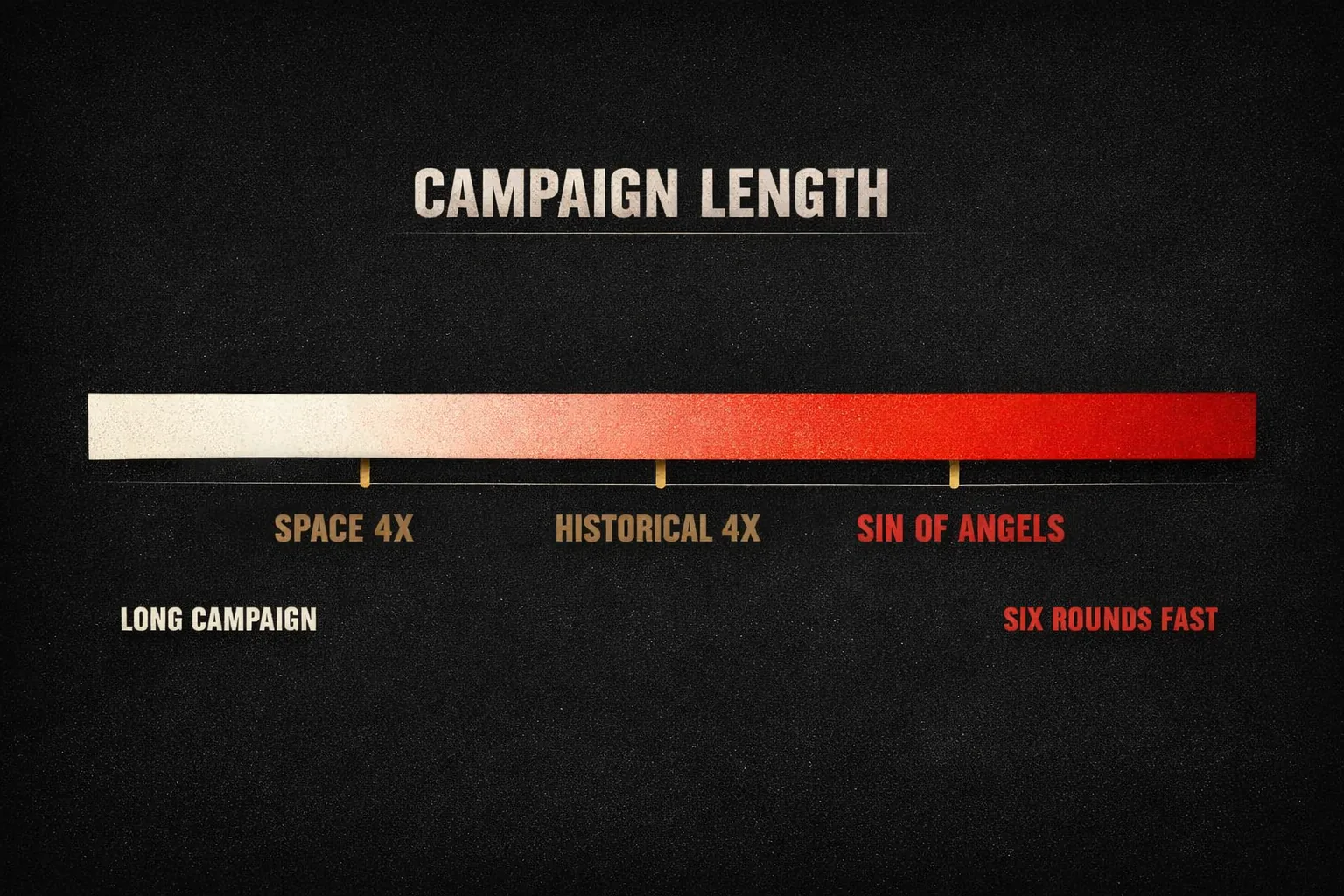
Run the Four-Pillar Gut Check above against our outlaw-MC strategy board game, Sin of Angels, and it clears all four, just compressed into a night instead of a weekend. We took the brutal area-control mechanics of tabletop gaming and dropped them into the gritty underbelly of an LA-adjacent California town.
You start by building your crew. You bring in patched members and recruits. Then you expand. You move your bikers onto the town's sites. Every location is a front, including:
- The dive bar
- The Iron Works
- The Morgue
- Picket Fence Lab
- High Desert Trading Post
- San Pedro Docks
Once you hold the turf, you use it. You run guns, move narcotics, and bleed the local economy dry for cash. You trade on the Silk Road and manage your felonies with the law. You spend your orders each turn to build up your strength.
When a rival club steps on your territory, you exterminate. You do not just roll a die and read a text box. When clubs clash on a site, it triggers a Brawl: a cinematic 3D battle where someone leaves in an ambulance. You watch atmospheric death vignettes when a rider goes down.
Simple goal: You cut deals, forge ceasefires, and break them when the time is right. The goal is simple: hold the most cash when the game ends after round 6.
You can play it your way:
- Run it solo against a smart AI opponent
- Jump online for multiplayer with friends across different devices
- Host a game night with our party mode: throw the 3D board up on a TV, and everyone plays from their own phone
There is no software to install. It is a browser-based game, so it works on any device. iPhone users will play right in the browser once the beta opens. A native Android app is on the way, and a PC release via Steam is coming. Get on the beta list, claim your turf, and bury the rest when it drops.
Join the Beta
Sin of Angels is in closed beta at soa-game.com. Get on the list and you play early, and the bugs you report shape what ships.
Related Guides
- Sin of Angels: The Outlaw Motorcycle Club Strategy Board Game
- Engine-Building Board Games: How the Mechanic Works + Best Picks
- Area Control Board Games: How They Work and What to Play
- Hidden Movement Board Games: Cat-and-Mouse Strategy Explained
Frequently Asked Questions
What does 4X stand for in gaming?
The term stands for explore, expand, exploit, and exterminate. These four actions form the core gameplay loop of the genre. Players must uncover the map, claim territory, harvest resources, and destroy rival factions to win.
What is the difference between a 4X game and a grand strategy game?
In a 4X game, all players start with a small presence on an unexplored map and build their empires from scratch. Grand strategy games drop players into an established world map with pre-existing nations of unequal power. Grand strategy focuses more on complex politics and diplomacy than pure expansion.
What was the first 4X game?
Early space exploration and empire-building titles laid the groundwork for the mechanics long before the term existed. Classic strategy games defined the core loop of exploring blank maps and exploiting resources to fund a war machine. The genre has since evolved into massive digital and tabletop campaigns.
Are 4X games hard to learn for beginners?
They can be intimidating because they feature deep menus, complex resource economies, and long playtimes. However, most modern titles include extensive tutorials and scalable difficulty settings. Beginners can start on smaller maps against easy AI opponents to learn the basic loop before jumping into massive campaigns.
What is the difference between turn-based and real-time 4X games?
Turn-based titles allow players to take their time, plan their moves, and manage their economies without a ticking clock. Real-time games force players to make decisions, move units, and build structures simultaneously on the fly. Turn-based games feel like a complex board game, while real-time games demand faster reflexes and quick thinking.
Ride Out on Top
Whether you are colonizing a galaxy or taking over a small California town, the rules are the same. Strategy games reward the players who plan ahead and strike hard. Build your crew, claim the best turf, and bleed the Silk Road dry. Claim Your Spot in the Beta and help shape the game before it ships.