Negotiation Board Games: Deals, Alliances, and Betrayals

A negotiation board game is a tabletop or digital strategy game where you win above the table, not just on it. Diplomacy, Chinatown, and Bohnanza are three of the genre's heaviest hitters. You cut deals, trade resources, and forge alliances with other players to get ahead. The rules just set the framework.
Key Takeaways
- Negotiation games are won in conversation; the rules just set the stakes, not the outcome.
- Binding deals (Chinatown, Bohnanza) are enforced by the rules; non-binding deals (Diplomacy) live on trust alone.
- A weak board position can talk its way into a win by turning rivals against each other.
- Area control and 4X strategy both lean on negotiation to buy time or avoid two-front wars.
- Sin of Angels keeps every ceasefire non-binding: the game itself never enforces a promise you make.
You talk your way into power. You convince rivals to back off. You make promises you have no intention of keeping. These games force player interaction, so you cannot win by staring at your own pieces and solving a private puzzle.
What separates this genre from the rest:
- A brilliant tactical move can be undone in seconds if the table decides you are a threat and teams up against you.
- A player with a weak board state can talk their way into a winning position by turning enemies against each other.
- It comes down to who has the advantage, who can persuade, and who moves at the right moment.
Whether you are swapping property deeds in a trading game or dividing up galactic sectors in a space opera, the tension stays the same. You need what they have. They need what you have. The only question is who walks away with the better end of the deal.
The Anatomy of a Deal
The best negotiation board game experiences do not happen on the cardboard. They happen in conversation, and the mechanics just set the stakes. You might be trading commodities, dividing up territory, or deciding who gets attacked. The rules dictate what you can trade and when, but they rarely force you to tell the truth.
When you play negotiation games for groups, the dynamic at the table shifts. It is not just about having the best strategy. You need to read the room: who is desperate for cash, who holds a grudge from last round, who is quietly pulling ahead.
At the table, you might:
- Bleed your friends dry with bad trades
- Team up to take down the current leader
- Break the alliance the moment it stops serving you
That is the hook. The mechanics force interaction, so you cannot win in a vacuum.
Teaching value: Educators have noticed the same psychology. They use negotiation games for students to teach game theory, conflict resolution, and basic economics. Players learn fast that a deal only works if both sides feel like they are winning.
The balance: Squeeze someone too hard, and they will refuse to trade with you for the rest of the game. Be too generous, and you hand them the win. Finding that thin middle ground is the core of the genre.
Binding vs. Non-Binding Agreements

Most games handle deals one of two ways: binding, or non-binding. Binding agreements are enforced by the rules of the game. If you trade three sheep for two wood, the transaction happens immediately. Neither player can back out. The negotiation is about finding the right price, not worrying about a double-cross.
Non-binding agreements are where friendships go to die. These are promises about future actions. You agree not to attack my territory this turn. In exchange, I agree to back your attack on a mutual enemy next turn.
The game does not enforce this. When next turn rolls around, I can absolutely leave you out to dry. The tension in non-binding games comes from trust. You have to figure out if your ally is real, or if they are setting you up for a massive betrayal.
That non-binding trust problem is the entire engine behind Sin of Angels. Every ceasefire you cut with a rival club is a promise the game itself will never enforce, and that's the point. The game is in closed beta now, and the list is open.
Heavy Hitters of the Genre
Tabletop history is full of titles that run on table talk. If you check the best negotiation board games reddit threads, a few heavy hitters always surface. These games span different themes and complexity levels, but they all share a reliance on deal-making.

Diplomacy
This is the grandfather of ruined friendships. It is a game of pure negotiation with zero luck and inevitable backstabbing. Players control European powers prior to World War I. Combat is deterministic. If you bring more armies to a fight than the defender, you win.
Because everyone starts with roughly equal strength, you cannot expand without help. You have to form alliances. You spend twenty minutes whispering in the hallway with another player, coordinating a joint strike. Then you write down your orders in secret. When the orders are revealed, you find out if they kept their word.

Cosmic Encounter and Twilight Imperium
If you want a space negotiation board game, these two set the standard. Cosmic Encounter is a chaotic game of alien races breaking the rules. Every turn involves an attack. Both the attacker and the defender can invite other players to join in as allies.
Twilight Imperium is a massive, all-day epic. You build galactic empires, research tech, and build massive fleets. But you only survive by cutting deals, forming temporary truces, and voting on galactic laws that screw over your rivals.
Chinatown and Bohnanza
These represent the pure trading side of the genre. In Chinatown, players draw random property lots and business tiles. To score big, you need matching tiles on adjacent lots. You will never draw what you need. You have to trade. Everything is negotiable: lots, tiles, cash, or future promises.
Bohnanza is a lighter card game about planting beans. You must plant the cards in your hand in order. That means you are constantly forced to trade away beans you do not want. Otherwise you rip up your own fields. The haggling is fast, loud, and ruthless.
Sidereal Confluence and Zoo Vadis
These titles thrive on complex, asymmetrical trading. In Sidereal Confluence, everyone plays a radically different alien species with unique economies. You all have something someone else needs to run their economic engine.
Zoo Vadis is a political game where animals campaign for control of a zoo. You have to bribe other players to vote for your advancement.
At a Glance: How These Negotiation Games Trade
| Game | Players | Time | Complexity | Trading Style | Vibe |
|---|---|---|---|---|---|
| Diplomacy | N/A | N/A | N/A | Secret alliances, written orders, no luck | Pure negotiation, ruined friendships |
| Cosmic Encounter | 3-5 | 60-120 min | 2.58/5 | Invite allies into any attack or defense | Chaotic, rule-breaking |
| Twilight Imperium | 3-6 | 240-480 min | 4.36/5 | Truces, tech deals, galactic law votes | Massive, all-day epic |
| Chinatown | 3-5 | 60 min | 2.22/5 | Trade lots, tiles, cash, or promises | Pure property trading |
| Bohnanza | 2-7 | 45 min | 1.67/5 | Constant bean haggling to clear your hand | Fast, loud, ruthless |
| Sidereal Confluence | 4-9 | 120-180 min | 3.57/5 | Asymmetrical economic trades between species | Complex, engine-driven |
| Zoo Vadis | N/A | N/A | N/A | Bribe votes for advancement | Political |
| Sin of Angels | 2-6 | about 6 rounds | Not BGG-rated | Hidden-bid narcotics economy (The Silk Road), plus non-binding ceasefires you're free to break | Browser-based turf war where nobody's word is enforced by the game |
How to Pick Your Game: The Binding-or-Bluff Test

Every game above answers one question differently: does it force your deals, or let you break them? Use that split as your filter.
- Want the rules to hold people to their word? Pick a binding-trade game, like Chinatown or Bohnanza. The tension sits in the price, not the promise.
- Want the drama of a broken promise? Pick a non-binding game, like Diplomacy, Twilight Imperium, or Sin of Angels. The tension sits in whether anyone kept their word. Our ceasefires break with zero warning too, though Sin of Angels is still in closed beta, so the online player pool is small for now.
- Want a night, not a weekend? Match the vibe column above to your group's patience. Bohnanza and Chinatown wrap fast. Diplomacy and Twilight Imperium eat a whole evening.
That is the whole lens: binding versus non-binding, plus how much table time you have.
Adjacent Mechanics
Negotiation rarely sits alone. It fuels other heavy strategy mechanics, adding a layer of social friction to tactical puzzles.
Area Control
In our guide on area control board games, we break down how players fight over territory on a map. Negotiation is the lifeblood here. When three players share a border, you have to talk your way out of a two-on-one war.
You cut a ceasefire, focus on a different front, and wait for the right moment to strike. Games like Root and Inis rely heavily on this dynamic. You cannot hold the map by force alone. You have to convince the table that someone else is a bigger threat.
4X Strategy
Explore, expand, exploit, exterminate. Check our guide on 4x games to see how massive empires clash. You cannot fight everyone at once in a 4X game. You need trade agreements and non-aggression pacts to buy time while you build your forces. The negotiation phase is just as important as the combat phase.
Engine Building
While often solitary, some engine builders force interaction. Read our guide on engine building board game mechanics to understand how players construct resource-generating loops. When resources are tight, trading becomes the only way to get your machine running.
Bringing the Hustle to the Screen
Pitches Sin of Angels, the site's own browser negotiation game, and its closed beta signup.

Good online negotiation board games are hard to find. Most digital adaptations enforce every deal automatically, which kills the whole reason a promise matters. Our outlaw-MC strategy board game, Sin of Angels, keeps the deal-making human instead.
This is a turn-based area-control game set in a California underworld. You run an outlaw motorcycle club warring for control of L.A. County. You build your crew by bringing in patched members and recruits, then take territory by muscling rival gangs off the streets.
You bleed L.A. County dry by using:
- Dive bars
- The Iron Works
- The Morgue
- Picket Fence Lab
- San Pedro Docks
The game runs entirely on deals and betrayals. You cannot hold all of L.A. County alone. You cut deals with rival clubs and forge ceasefires to protect your borders. You trade on The Silk Road and keep your Felonies in check with the law.

Then, when a rival leaves their flank open, you break the truce and roll in. Clashes between clubs trigger a Brawl: cinematic 3D battles with punchy sound effects and an original outlaw-country soundtrack. When a rider goes down, you get an atmospheric death vignette. Someone is leaving in an ambulance.
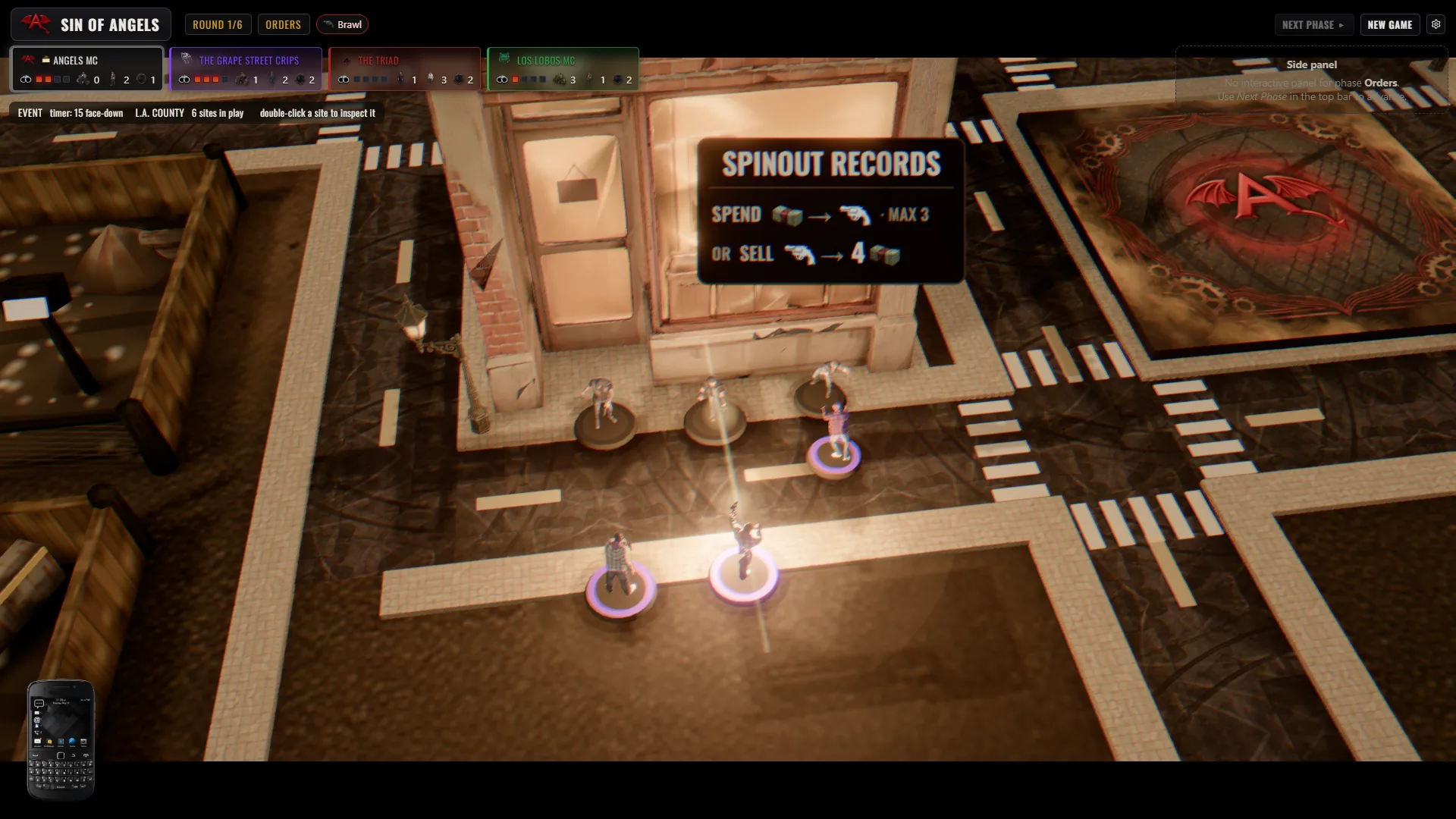
You play it directly in your browser, no install required. It works on:
- Desktop
- Tablet
- Phone, including iPhone via the browser
A native Android app is on the way, and a PC release is coming to Steam.
Play your way:
- Run a solo campaign against a smart AI opponent
- Play online multiplayer with friends across different devices
- Host a game night with our party mode: throw the 3D board up on the TV, and everyone plays from their phone
It is the perfect setup for cutting deals across the living room before stabbing your buddy in the back. A full game takes about six rounds: you claim your Sites, build your cash lead, and bury the rest.
Join the Beta
Sin of Angels is in closed beta at soa-game.com. Get on the list and you play early, and the bugs you report shape what ships.
Related Guides
- Sin of Angels: The Outlaw Motorcycle Club Strategy Board Game
- What Are 4X Games? Explore, Expand, Exploit, Exterminate Explained
- Engine-Building Board Games: How the Mechanic Works + Best Picks
- Area Control Board Games: How They Work and What to Play
Frequently Asked Questions
Is Catan a negotiation game?
Yes. While it is primarily a resource management and building game, trading is a core mechanic. Players must negotiate with each other to swap resources like sheep and wood. The player who negotiates the best deals usually wins.
What is the negotiation game?
A negotiation game is a strategy genre where players must communicate, trade, and form alliances to advance their position. The mechanics require players to interact directly to secure resources or territory. Success depends on persuasion, advantage, and timing your betrayals.
What makes a board game a negotiation game?
A game fits this genre if player interaction and deal-making are required to win. If you can win simply by optimizing your own puzzle without talking to anyone, it is not a negotiation game. The rules must allow players to trade assets, make promises, or coordinate attacks.
Can you play negotiation board games online with friends?
Yes. Many tabletop negotiation games have digital adaptations available on platforms like Steam or through web browsers. Digital versions often include built-in chat or voice integration to facilitate table talk. You can also play modern digital-first strategy games that build alliances and betrayals directly into the mechanics.
What is the best negotiation board game for beginners?
Bohnanza and Chinatown are excellent starting points. They feature simple rules focused entirely on trading and haggling. Players learn how to value assets and read their opponents without getting bogged down in complex combat or movement rules.
Do negotiation board games work well as party games?
They can, provided the group enjoys high interaction and conflict. Games with heavy negotiation require players to be vocal and engaged. Digital board games with party modes are great for large groups. Everyone plays from their phone while watching a shared screen.
Claim Your Turf
A great negotiation game tests your strategy and your friendships. Whether you are trading commodities or fighting over turf, the best deals get broken at the perfect moment. Ready to claim your Sites and run L.A. County? Get Early Access to Sin of Angels now.