
Push-Your-Luck Board Games: The Best Risk-It-All Picks

The best push your luck board games are Can't Stop for pure dice math, Incan Gold for hidden-information dread, The Quacks of Quedlinburg for a tactile bag-pull bust, Deep Sea Adventure for shared-risk panic, and Galaxy Trucker for a puzzle bolted onto the gamble. Every one runs on the same question: do you walk away with what you have, or risk it all for a bigger score?
You roll the dice, flip the card, or pull a token from the bag. Each choice ratchets up the tension in the room:
- Push too far and you lose everything you built that turn.
- Stop too early and you watch someone else take the prize.
- It's raw, unfiltered tabletop gambling, minus the real-world bankruptcy.
No massive rulebook required. The best push your luck games strip away the complicated math and leave you with pure instinct. They test your nerve. They reveal who plays it safe and who can't resist going for the throat.
The payoff is massive emotional swings, whether you're hosting a casual game night or need a fast filler between heavy strategy sessions. You will cheer. You will curse. You will swear you're done. Then you'll roll the dice one more time.
Key Takeaways
- Push your luck games force one repeated choice: bank your progress, or risk it all for more.
- Three engines drive the genre: transparent dice math, hidden-information cards, and tactile bag-pulls.
- Can't Stop, Incan Gold, and The Quacks of Quedlinburg each represent one of those three engines at its best.
- The mechanic pairs naturally with engine building, exploration, and area control in heavier games.
- Sin of Angels bolts the same push-your-luck dread onto every Site you work against the law, currently in closed beta.
What Are Push Your Luck Board Games?
Defines the bank-or-bust loop and the dice, card, and bag formats, plus a beta pitch.
Push your luck board games are tabletop games where you repeatedly decide whether to bank what you have or risk losing it all for a bigger reward. The core mechanic forces you to weigh probability against your own greed.

Stop, and you bank your progress and end your turn safely. Push on and fail the game's bust condition, and you walk away with nothing.
Three formats, one core loop:
- A push your luck dice game might have you rolling for specific symbols, freezing the ones that hit while you re-roll the rest to build a better combo.
- A push your luck card game usually relies on hidden information: you draw from a central deck, and pulling a duplicate symbol or hazard card instantly wipes out your hand.
- The rules are always simple to grasp. The choices are never easy to make.
It's the purest form of risk management printed on cardboard. The mechanic works because it creates a direct link between player agency and dramatic failure. You can't blame a bad strategy when you bust.
You can only blame yourself for reaching back into the bag when you knew the odds were turning against you. That direct accountability is what makes the wins feel earned, and the losses sting just a little more.
If pressing your luck one run too far sounds like your kind of mistake, Sin of Angels is built on it. It's in closed beta now, straight into the browser once your seat opens up. Join the Beta
The Anatomy of the Bust: Why We Risk It All
Explains why players bust: the commitment, escalation, breaking-point turn cycle.
The hook of the genre is the illusion of control. You know the odds, you know how many bad cards are left in the deck, and you know the dice are running cold. But the payoff is sitting right there, daring you to grab it.
The tension builds every single turn, turning a quiet living room into a loud, high-stakes casino floor. In the best push your luck board games, you're not just playing against the cardboard mechanics. You're playing against everyone else at the table.
When a rival banks a massive turn and takes the lead, the pressure shifts straight to you. You have to push harder just to keep up. That's exactly where the mistakes happen: greed takes the wheel, and logic goes out the window.
The Three Phases of a Standard Turn
- Commitment: You make the initial move. You get a small reward. It feels safe.
- Escalation: You decide to go again. The odds of a bust increase, but the payout scales up.
- The breaking point: You have a pile of resources sitting in front of you. The smart move is to stop and bank the cash. But the crowd is egging you on. Your rivals are calling you a coward. You roll one more time.

When you bust, it hurts. You lose your turn, your loot, and your pride. The table laughs. But when you hit the jackpot against all odds, you own the room.
That emotional swing is why these titles hit the table night after night. They don't require deep strategic planning or hours of quiet calculation. They require nerve and discipline. They're the perfect push your luck board games for adults who want to talk trash, cut deals, and watch their friends crash and burn over a handful of plastic gems.
The Mechanics of Greed: Dice, Cards, and Bags
Breaks down how dice, card, and bag engines each trigger a bust, in general terms.
Three components create push-your-luck tension: dice, cards, and bags. Game designers use each one to tempt you differently, and every format carries its own psychological weight.

The Dice Game Engine
The push your luck dice game rules usually follow a familiar lineage. You roll a pool of dice. You must keep at least one scoring die to continue. You can then choose to stop and score your banked points, or pick up the remaining non-scoring dice and roll again.
If you ever roll and fail to hit a scoring face, you bust. You lose all points accumulated that turn. The tactile feel of shaking the dice adds to the drama. The math is transparent, but the dice do not care about the odds.
The Card Game Engine
A push your luck card game operates on hidden information. You draw from a deck one card at a time, looking for treasure, trying to build a set, or exploring a dungeon. The tension comes from the unknown hazard cards buried in the stack.
With every card drawn, the deck gets thinner and the odds of a bust card go up. Card games often add collective risk too: the whole table decides simultaneously whether to stay in the round or fold.
The Bag-Building Engine
The bag-building engine has you filling a personal cloth bag with good tokens and bad tokens, then pulling them out one by one. Modern titles have made this mechanic hugely popular. You upgrade your bag over the course of the game, adding better rewards while the bad tokens remain.
It's a brilliant tactile experience. You can feel the tokens in the dark. You know the bad one is in there somewhere. The physical act of reaching into the bag makes the inevitable bust feel incredibly personal.
The Best Push Your Luck Board Games on the Market
These five games deliver push-your-luck tension better than most of what else is on the shelf. The market is flooded with titles, but these are the ones that consistently bring the highest tension, the loudest groans, and the best table dynamics.

| Game | Format | Setting | The Bust Risk |
|---|---|---|---|
| Can't Stop | Dice | Abstract board of numbered columns | Rolling dice with no match to your three active columns |
| Incan Gold (Diamant) | Cards | Ruined temple exploration | A second identical hazard card collapses the temple |
| The Quacks of Quedlinburg | Bag-building | Potion market | Pulling too many cherry bomb tokens explodes your pot |
| Deep Sea Adventure | Dice | Shared submarine, deep-sea dive | The shared oxygen supply runs out before you swim back |
| Galaxy Trucker | Tile-building + cards | Space trucking | Hazard cards like meteors and pirates destroy your ship |
How to Choose: The Three-Engine Lens
Every game above runs on one of the three engines from the section above: dice, cards, or bags. Use that as your filter before you buy.

- Want fast, transparent math you can argue about? Pick a dice engine like Can't Stop or Deep Sea Adventure. The odds are visible on the table, so the tension comes from doing the math against your own nerve.
- Want hidden-information dread and a read on your friends? Pick a card engine like Incan Gold. You don't know what's left in the deck, so the tension comes from psychology, not math.
- Want a tactile, physical bust? Pick a bag-building engine like The Quacks of Quedlinburg. Reaching in blind and feeling for the token makes the bust personal.
Galaxy Trucker mixes tile-building with cards, so treat it as the wildcard pick if you want puzzle-solving bolted onto the bust. This is the filter a generic listicle skips: it ranks games by hype, not by which kind of dread you actually want at your table.

Sin of Angels bolts that same push-your-luck dread onto every Site you work: one more run before the law notices is always tempting. It's in closed beta now, no install once you're in. Get on the Beta List.
Can't Stop
This is the undisputed grandfather of the push your luck dice game. It is pure, unfiltered math and temptation. The board looks like a giant stop sign.
You roll four standard dice and pair them up to create two numbers, then advance markers up corresponding numbered columns on the board.
The catch is brutal. You can only advance in three specific columns per turn. If you roll the dice and cannot create a number that matches your three active columns, you bust and lose all progress for that turn.
It is stripped down, incredibly fast, and ruthlessly punishing. You will always think you can hit that seven just one more time. You will usually be wrong.
Incan Gold (Diamant)
This is a masterclass in the push your luck card game format. You and your friends are explorers diving into a ruined temple. Each turn, a card is flipped from the deck. It reveals either a pile of treasure or a deadly hazard like giant spiders or falling rocks.
Before the next card is flipped, every player secretly decides whether to stay in the temple and keep exploring, or run back to camp and bank their share of the loot. If a second identical hazard card is drawn, the temple collapses. Everyone still inside loses everything.
It's a psychological exercise in reading your friends. Do you stay because they left, hoping to claim all the remaining treasure for yourself? Or do you run because the odds are getting too hot?
The Quacks of Quedlinburg
This modern hit took the genre and wrapped it in a brilliant bag-building system. You play as rival charlatans brewing potions to sell at a local market. You blindly pull ingredient tokens from your personal bag and place them on your player board to increase the value of your brew.
The catch: your bag is also seeded with cherry bombs. If the total value of the cherry bombs you pull exceeds a certain limit, your pot literally explodes. You suffer penalties and lose the ability to score victory points or buy better ingredients for that round.
The tension of reaching into that bag is unmatched in modern tabletop gaming. You know a single white three-value token could ruin your entire turn.
Deep Sea Adventure
Do not let the tiny box fool you. This game carries massive stakes and a vicious player dynamic. You and your rivals are broke deep-sea divers sharing a single submarine and a single, limited pool of oxygen.

The twist: you roll dice to dive deeper into the ocean to collect better treasure tokens. But the deeper you go, and the more treasure you strap to your back, the more oxygen you burn from the shared track. That cost gets paid at the start of your turn.
If the collective air supply runs out before you swim back to the sub, you drown and drop all your loot on the ocean floor. It forces players into a collective panic. One greedy player diving too deep can suffocate the entire crew.
Galaxy Trucker
This title blends chaotic real-time puzzle solving with a brutal test of endurance. The game happens in two phases. First, you frantically dig through a pile of cardboard tiles to build a spaceship out of plumbing pipes, laser cannons, and crew cabins before the timer runs out.
Phase two: you fly that duct-taped monstrosity through a deck of hazard cards. Meteors smash your ship to pieces. Space pirates board you and steal your cargo. You are constantly pushing your luck just by staying in the race.
You hope your ship holds together long enough to cross the finish line and make a profit. It is hilarious, punishing, and completely unpredictable.
Beyond the Bust: Mechanics That Pair Perfectly
Covers how push-your-luck pairs with engine building, exploration, and territory.
Push your luck rarely sits alone as a mechanic. Designers bolt the risk-it-all engine onto other systems to create deeper strategy:
- Engine building: you push your luck to gather the exact resources you need to buy a card that makes your next turn even stronger. See our guide on engine-building board games. The gamble accelerates your engine, but a bust leaves you stalling out while your rivals pull ahead.
- Exploration: if you read our guide on 4X games, you know the tension of flipping an unknown map tile. You send your scouts into the fog. You might find a rich resource cache, or you might wake up a hostile alien fleet that wipes out your crew.
- Territory: in many area control board games, combat relies on dice or hidden cards. You commit your plastic miniatures to a fight, then roll the dice hoping for a critical hit. A bad roll means you lose the turf and your army, so the gamble forces you to weigh the value of the land against the cost of the blood.
Sin of Angels: High Stakes on The Silk Road
Pitches Sin of Angels: the Felonies track, 3D Brawls, and online, solo, or party play.
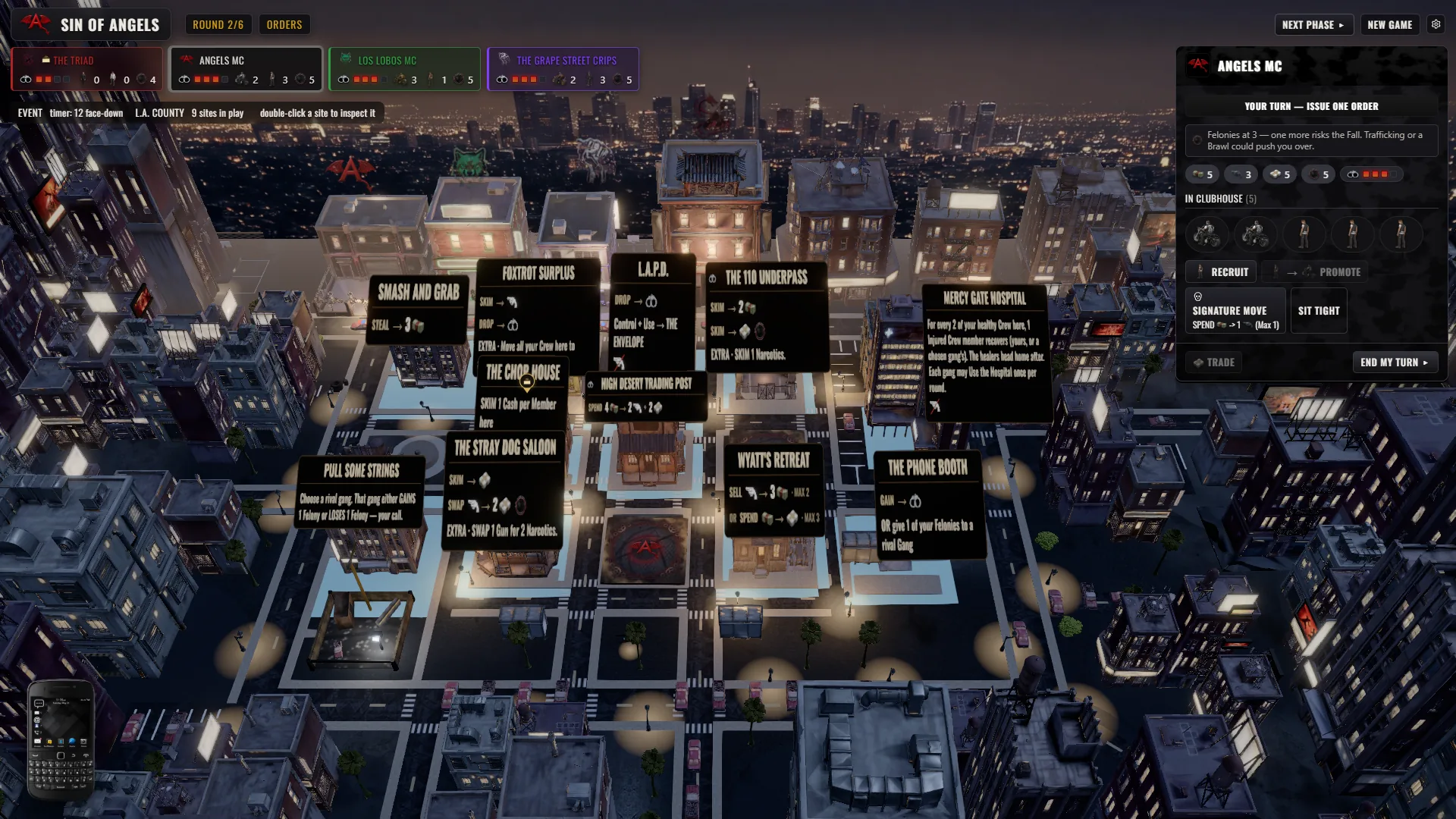
Bust mechanics work because the greed is yours alone. Sin of Angels wires that same dynamic into a whole board: every extra Site you work is a gamble against the law, not a card flip against a deck. Play our outlaw-MC strategy board game and you're in charge of a biker club fighting for control of L.A. County.
You bring in patched members and recruits, muscle rival gangs off their turf, and run guns and narcotics to bleed the local economy dry.
The Gamble at the Table
Every turn forces a hard choice. You can play it safe, or you can push your luck to use one more Site before you rack up too many Felonies. Cut deals with rival clubs, then break them when the time is right. Hold the most Cash when the six rounds run out and you win the town.
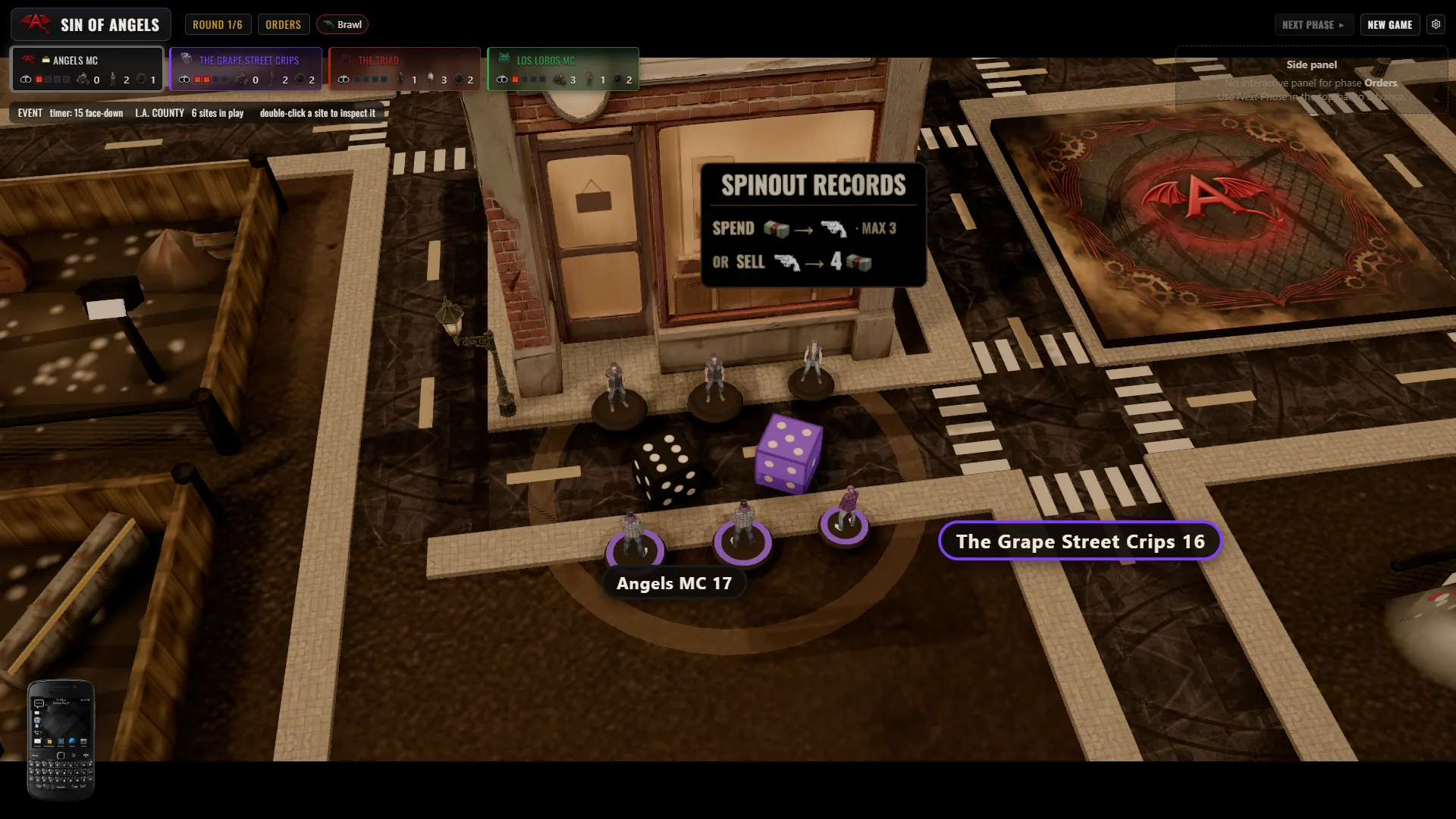
When the talking stops, you settle it in the dirt. Gang fights play out as cinematic 3D Brawls where you commit your guns, roll the dice, and see who rides away.
How You Can Play
- No table required. This is a digital board game built for the browser. There is no install, and it runs on any device, including your iPhone. Sin of Angels is coming to Steam for PC, and a native Android app is on the way.
- Online: if you are looking for push your luck board games online, you can run a private lobby with your friends across the country.
- Solo: play against a smart AI opponent.
- Party mode: host a game night, throw the 3D board up on the TV, and let everyone plot their moves in secret from their own phones.
Get In Early
Sin of Angels is in closed beta at soa-game.com. Get on the list, play early, and the bugs you report help shape what ships.
Related Guides
- Sin of Angels: The Outlaw Motorcycle Club Strategy Board Game
- What Are 4X Games? Explore, Expand, Exploit, Exterminate Explained
- Engine-Building Board Games: How the Mechanic Works + Best Picks
- Area Control Board Games: How They Work and What to Play
Frequently Asked Questions
What does push your luck mean in board games?
It is a core mechanic where players decide whether to keep their current progress or risk losing it all for a bigger reward. Every turn forces you to calculate the odds of success against the penalty of failure. If you push too far and fail the game condition, you bust and lose your gains for that round.
What are the best push your luck board games for adults?
Titles like The Quacks of Quedlinburg and Incan Gold are perfect for adult game nights. They feature simple rules but create massive psychological tension. The real game happens above the table as players talk trash, bluff, and pressure each other into making bad bets.
What is the difference between push your luck and pure luck games?
Pure luck games rely entirely on random chance, like rolling a die to move a pawn. Push your luck games give the player agency. You always have the choice to stop and bank your points, making the inevitable bust a direct result of your own greed rather than just a bad roll.
Are push your luck games good for game night with a group?
They are excellent for groups because they keep everyone engaged. Turns are usually fast, and the stakes are highly visible. Watching a friend risk everything on a single dice roll creates a spectator sport atmosphere that gets the whole room cheering or groaning.
What board game mechanics pair well with push your luck?
Designers frequently combine it with bag building, engine building, and area control. You might push your luck to gather resources faster, or risk your units in a dice-driven combat system to claim territory. The risk mechanic adds a layer of tension to long-term strategic planning.
Risk It All
The best tabletop experiences make you sweat for the win. Whether you are rolling dice at the kitchen table or playing push your luck board games online, the thrill lives in the gamble. Grab your crew, get on the beta list, and see who has the nerve to claim the town first. Claim Your Spot in the Beta